Home
Home is what you see when you open Manifest. It is a briefing rather than a dashboard: the greeting, the Ask bar, what Manifest noticed, and a cluster of figures on the right.
- For
- A briefing on opening Manifest: greeting, Ask bar, notices, fleet briefing and instrument cluster.
- Will not
- The warranty and lease windows of 90 days are fixed here and do not follow the warning periods that drive the matching chips on Assets.
- Writes
- Applying a suggestion action updates the asset and reloads the page so every count reflects it; the page does not say whether it is attributed or audited.
What you are looking at
Two columns. The narrative on the left, the instruments on the right, and a strip of suggestions along the bottom when there are any.
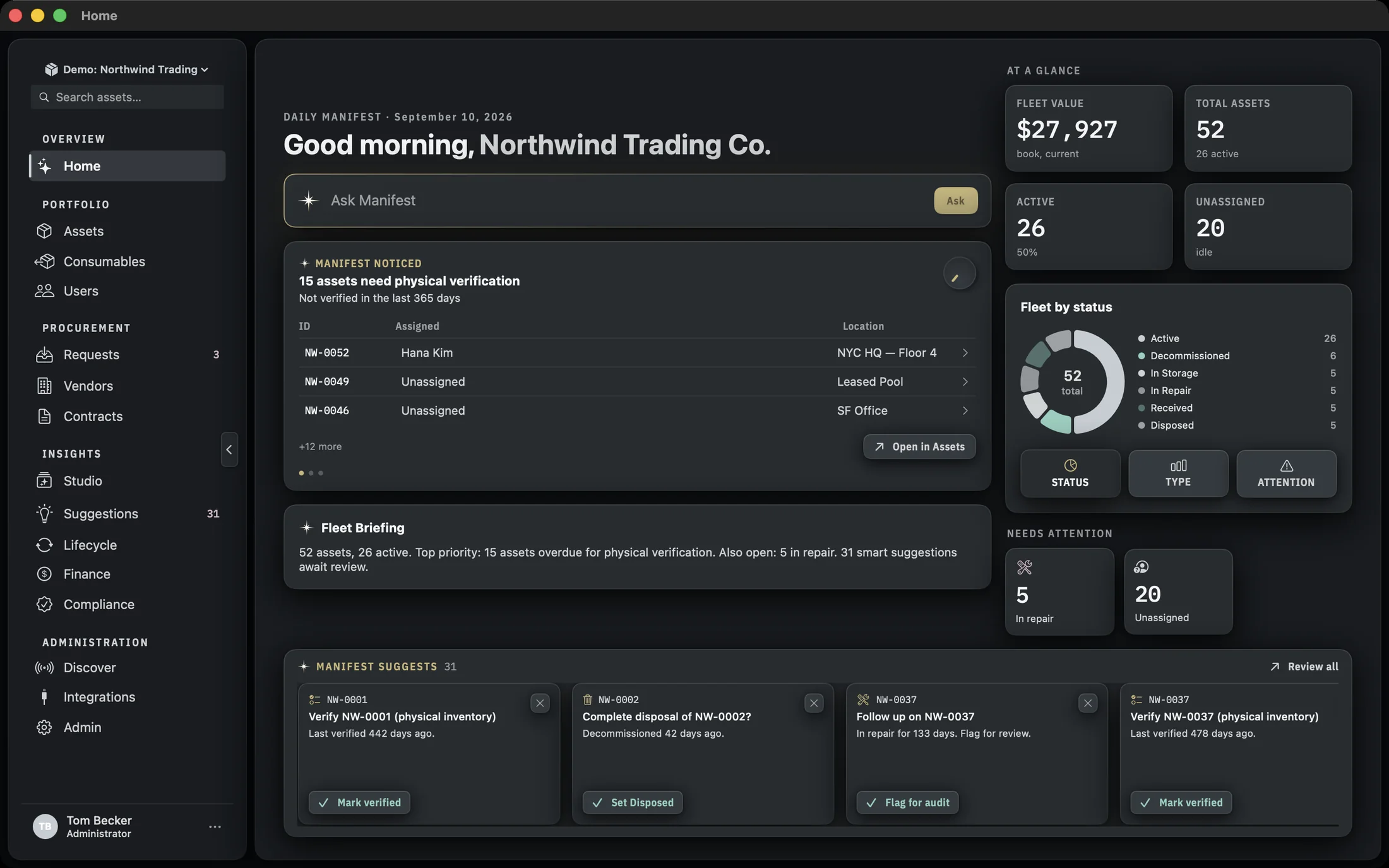
The header reads DAILY MANIFEST followed by today’s date, then a greeting that changes with the hour: Good morning, Good afternoon or Good evening, followed by your organisation name, or Your fleet if none is set.
At normal text sizes the page does not scroll. It is laid out to fit the window, with the suggestions strip pinned to the bottom edge. At enlarged text it scrolls instead, because a large-text reader should never get silently clipped content.
Asking a question
The Ask bar is the way in. Type a question, press Ask or Return, and the answer appears in a card below it.
The field is labelled Ask Manifest. The Ask button is disabled until you have typed something. Answers are grounded in your own register: the assistant reads the assets and metrics behind the question rather than describing them in the abstract, and any asset it refers to appears as a tappable row under the answer that opens that record in Assets.
While it is working the card reads Checking your assets…. The answer text is selectable, and the card has a dismiss control in its top right.
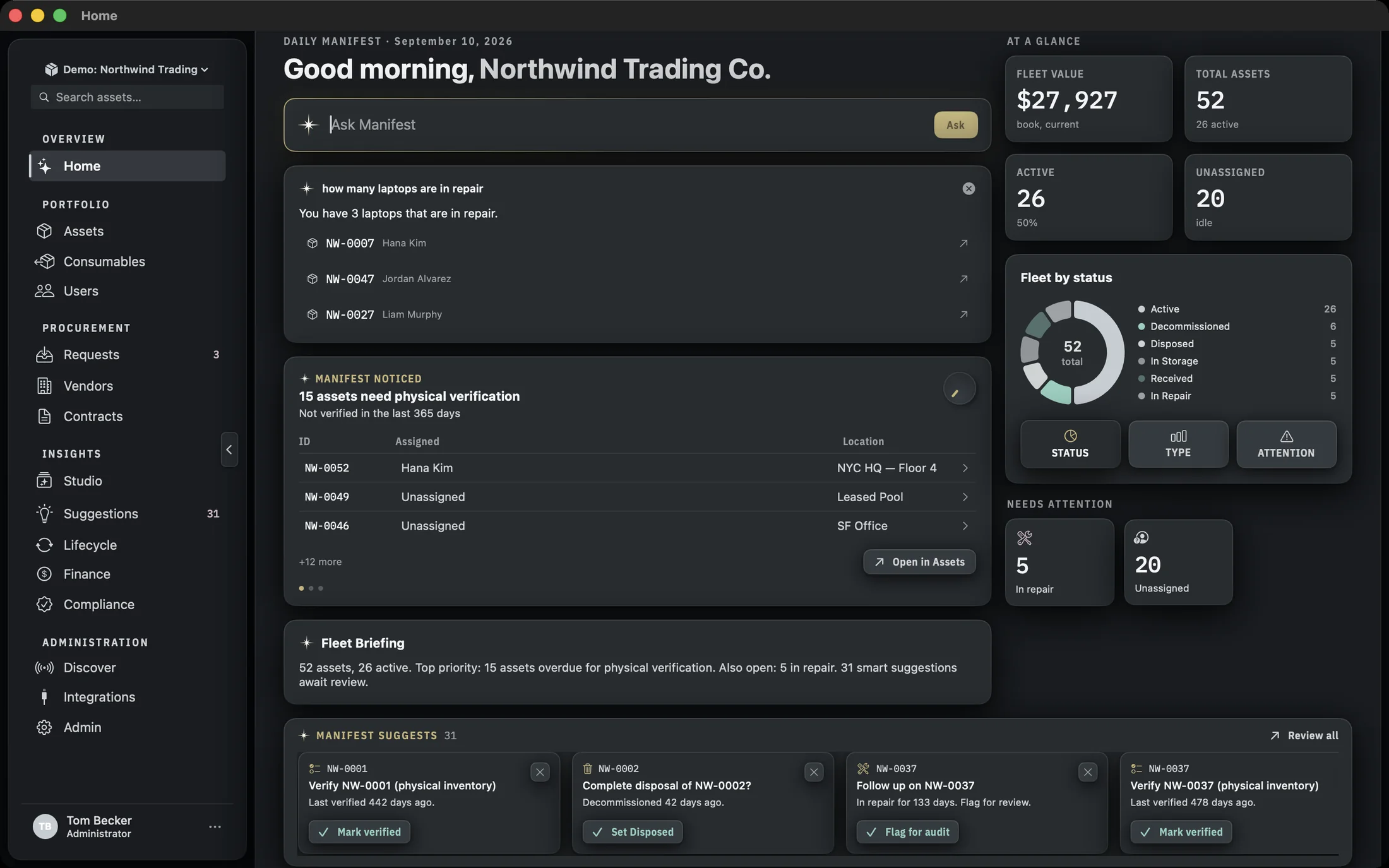
The Ask bar does two jobs. If what you type looks like a request for a chart, a graph, a dashboard, a breakdown, a trend, or anything containing by , it opens the Studio with that request instead of answering inline. Everything else is answered on the Home.
What Manifest noticed
One finding at a time, with the assets behind it, and a knob to turn to the next.
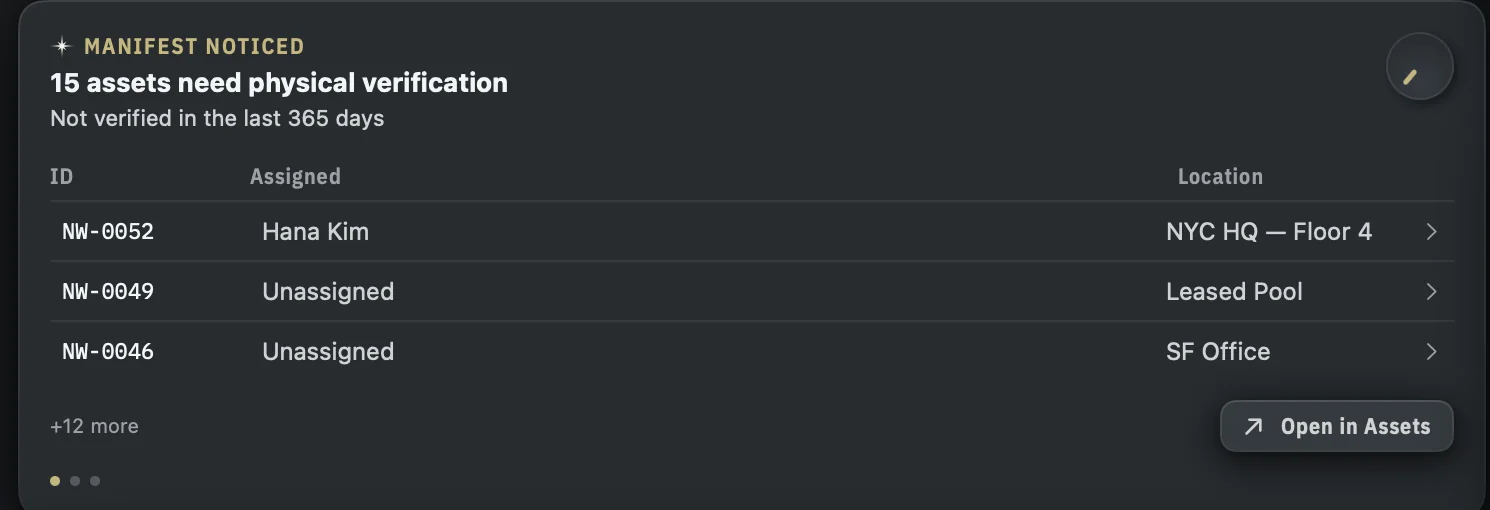
The card is headed MANIFEST NOTICED. Each finding has a headline such as 15 assets need physical verification, a detail line explaining the window, and a mini table of up to three assets with their tag, holder and a context column whose heading changes with the finding: Warranty ends, Lease ends, or Location.
The two windows are not the same kind of thing. Not verified in the last 365 days follows the physical inventory cadence set in Admin, so that number is yours. Within the next 90 days on the warranty and lease findings is fixed here, and does not follow the warning periods that drive the matching chips on Assets.
If there are more than three, a line under the table reads +N more. Clicking any row opens that asset. The knob cycles through every finding that has assets behind it, ordered by severity: verification overdue first, then warranties and leases, then repairs and renewals, then unassigned.
When nothing is wrong the card reads All clear. Nothing needs attention right now.
The fleet briefing
A short written summary of the numbers above it, generated on the device.
The card is headed Fleet Briefing. While it is being written it reads Reviewing your fleet… with a spinner. When there is nothing to say it reads Nothing needs your attention right now.
The briefing is a narration of the deterministic metrics the rest of the Home is built from: total assets, active, in repair, unassigned, overdue audits, warranties and leases expiring, contracts due for renewal, and the count of pending suggestions. The model describes those numbers; it does not invent them.
The instrument cluster
Four figures, one switchable chart, and up to three cards for what needs attention.
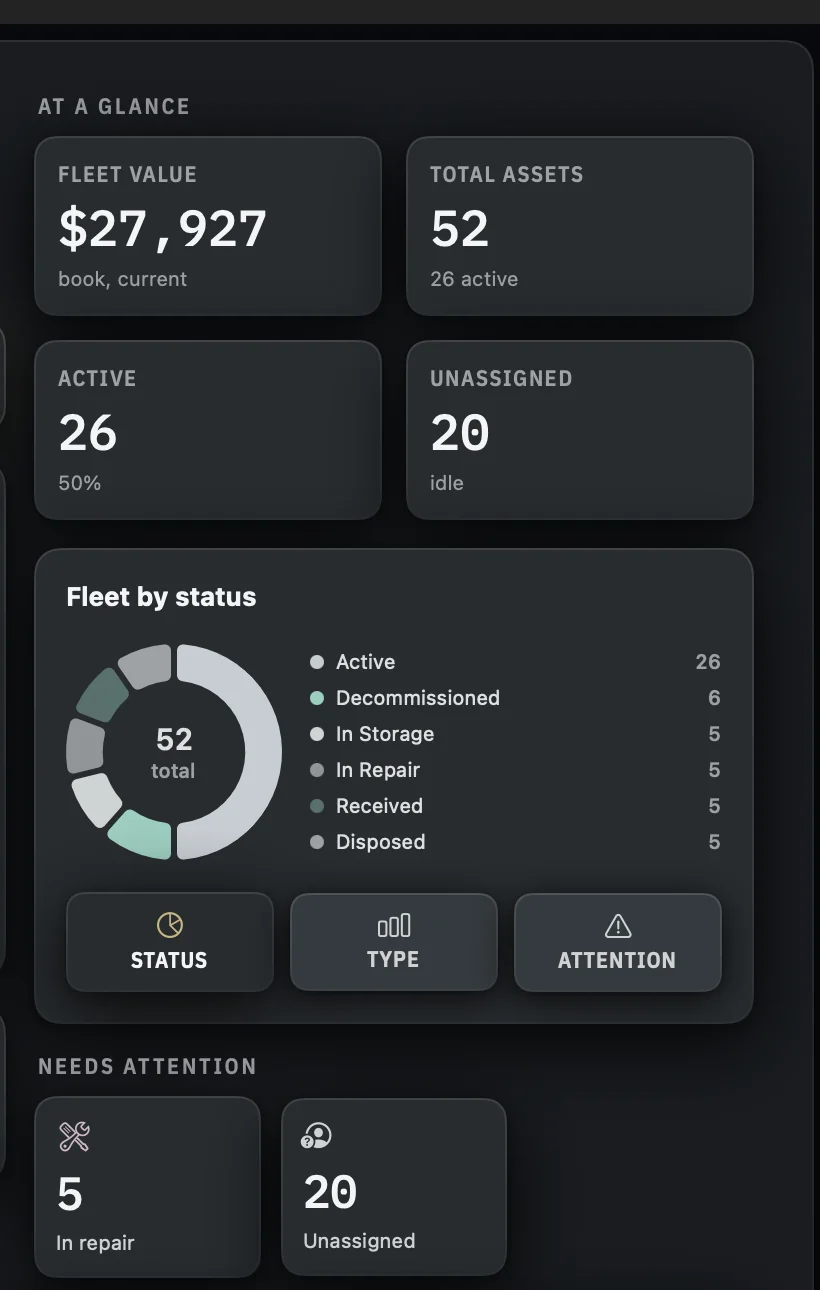
The four tiles are Fleet value (book, current), Total assets (with the active count underneath), Active (with the percentage of the fleet), and Unassigned (with the word idle).
The chart has three faces, chosen by the three buttons underneath it. STATUS draws a donut of the fleet by status, titled Fleet by status. TYPE draws a bar chart of the fleet by type, titled Fleet by type. ATTENTION draws a bar chart of what needs attention, titled Needs attention, broken down by kind: Verify, Repair, Warranty, Lease, Renew, Idle.
The donut’s legend lists every sector, not just the top few, because the rarest statuses are the ones an operator is usually hunting for. The figure in the middle of the donut is the sum of the sectors, labelled total.
Under the chart, NEEDS ATTENTION shows up to three cards, each with a count and a label: Verification overdue, Warranties expiring, Leases ending, Contracts to renew, In repair, Unassigned. Clicking a card opens the matching list: the first five go to Assets with the relevant filter, and Contracts to renew opens Contracts.
The featured finding in the notices card is removed from the attention grid, so the same count does not appear twice on the page.
Suggestions
A strip along the bottom, when the suggestion engine has anything to say.

The strip is headed MANIFEST SUGGESTS with a count beside it, and Review all on the right opens the Suggestions inbox. Up to eight chips are shown, scrolling horizontally.
Each chip has an asset tag, a title, a detail line, and one action. When the action can be applied from the Home the button reads its own label with a checkmark; when it cannot, the button reads Open with an arrow. Applying an action updates the asset and reloads the page, so every count on the Home reflects it.
Dismissing a chip hides it for the rest of the session. It reappears on the next launch if the suggestion is still valid.
Your charts
Charts you have pinned from your dashboards, rendered on the Home.
If you have pinned any dashboard charts to the Home, they appear in a strip headed YOUR CHARTS, between the two columns and the suggestions. Each card is the same widget you pinned, rendered with the same renderer the dashboards use, so a chart looks identical wherever it appears.
Each card has an edit control that opens the Studio, and a Remove from Home control that unpins it. The pin order is yours, and a widget that has been deleted since you pinned it is dropped silently rather than shown as a broken card.
Composing the Home
Which panels appear, and in which column, is set in Admin.
The greeting and the Ask bar are always present. Everything below them is your choice: the notices card, the fleet briefing, the glance cluster, the chart, and the attention grid can each be shown or hidden, and each belongs to the left or right column. The layout is read when the Home opens, so a change in Admin shows the next time you visit.
The pinned charts strip appears only when you have pinned something. The suggestions strip appears only when there is something to suggest.