Assets
Assets is the register. Everything else in Manifest reads from it, writes to it, or reports on it, so most of what you do in a working week happens on this one screen.
- For
- Finding a machine, reading its record, and changing it — one at a time or two hundred at once.
- Will not
- Retire machines in bulk. Disposed is deliberately absent from the bulk menu, because two hundred disposals in one click produce two hundred records with no account of how they left, and the account is what an auditor asks for.
- Writes
- The asset record and its audit trail. Deleting is a soft delete: the row is hidden and its history kept, because a machine that existed still happened.
- On iPhone
- The Assets tab holds the same register, for reading, verifying and reassigning in front of the machine.
What you are looking at
Assets opens on a table of everything you hold. It is the default layout because a register is a list before it is anything else, and because the column set is yours to decide.
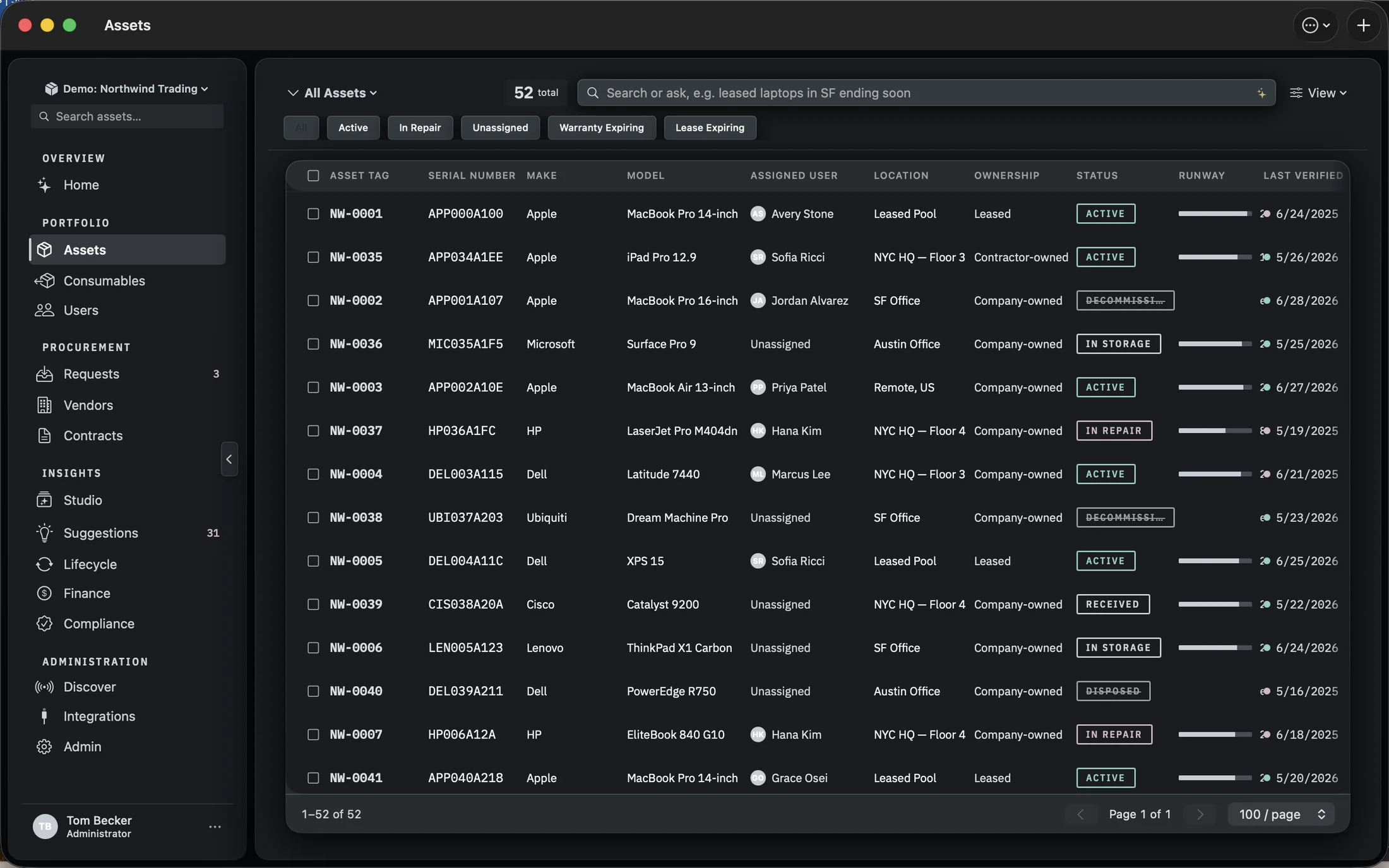
The top row is the whole control surface. Left to right: the saved view you are in, the count of what is currently showing against the total, the search box, and the View menu. Under it sit six filter chips, and under those the table itself with its pagination inside the same sheet, so the register reads as one object rather than a panel pinned to the window.
Selecting a row does not open anything. Activating one does: double-click it, press Return on it, or use the context menu, and you land on the record. That separation is what makes the checkboxes useful, because selecting fifty machines to act on them at once should not open fifty records on the way.
Finding one machine
The search box does two different jobs, and which one it is doing is always on screen.
Type, and it filters as you go. The match runs in the database across asset tag, serial number, make, model, assigned user and location, several words at a time, so it stays quick on a fleet rather than a demo. ⌘F puts the cursor in it from anywhere on the screen.
Press Return, and the sentence is parsed instead. The text is handed to Manifest, which turns it into filters: a status, a kind of device, leased or bought, unassigned, a lease ending soon. A banner appears under the controls with the question you asked and a line saying who answered it, either the on-device model or the deterministic parser that backs it up. There is a Clear on the right of the banner, and the chips come back the moment you use it.
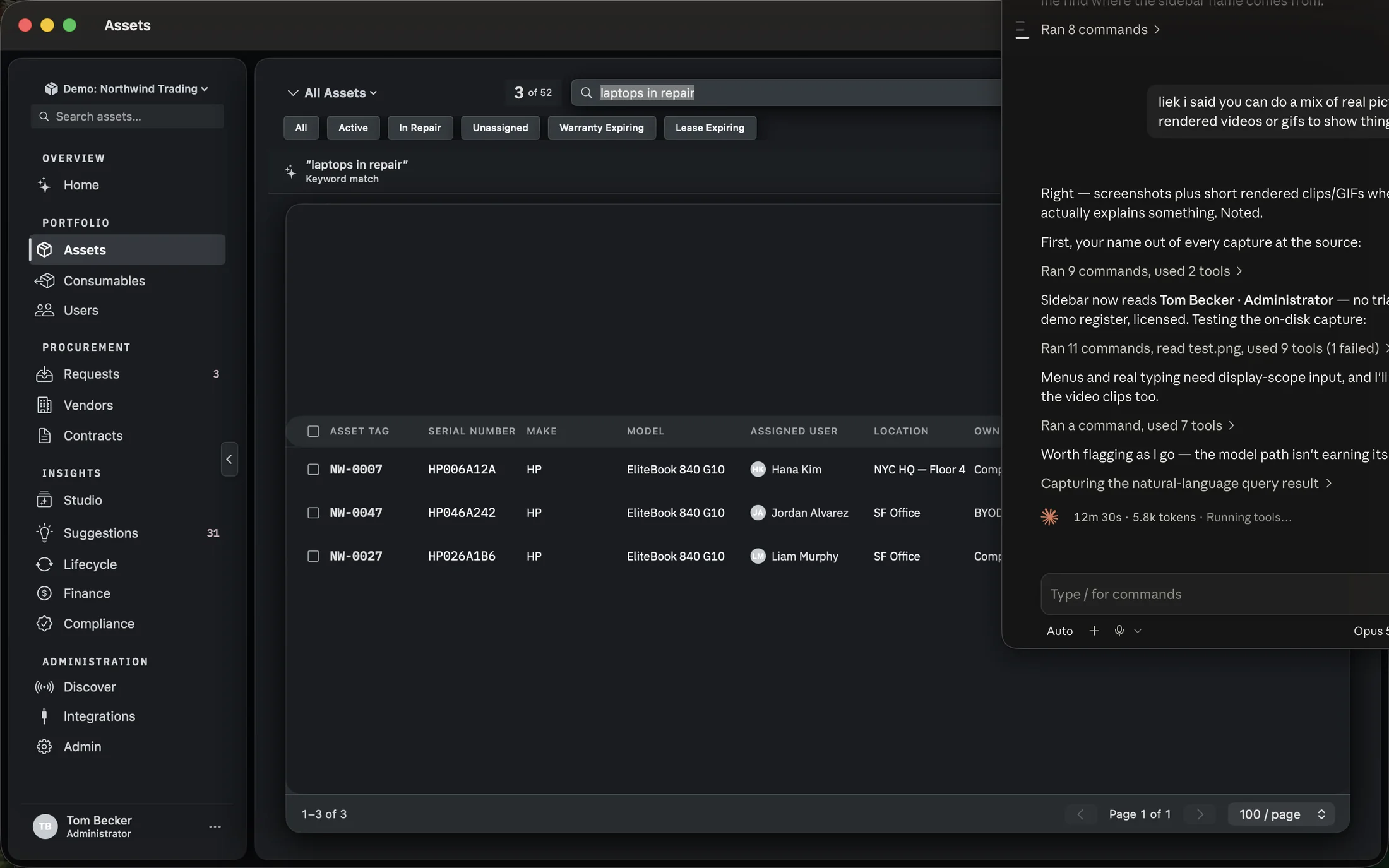
Both paths are local. There is no server in this feature, which is also why the answer to a vague question is sometimes an empty table rather than a guess: an inventory that invents matches is worse than one that says it found nothing.
Narrowing the whole list
Chips for the six questions worth one click, saved views for the ones you ask every week.
The chips are All, Active, In Repair, Unassigned, Warranty Expiring and Lease Expiring. The last two are not fixed windows: they use the warning periods set in Admin, so if your policy says ninety days, that is what the chip means.
The menu on the far left, showing All Assets until you change it, is saved views. A view carries its own filter and its own column set, so “Leased, ending this quarter, with cost and vendor” is one click rather than four. New View and Edit are at the bottom of that same menu.
Changing what the table shows
One View menu, holding the four things that alter the shape of the screen.
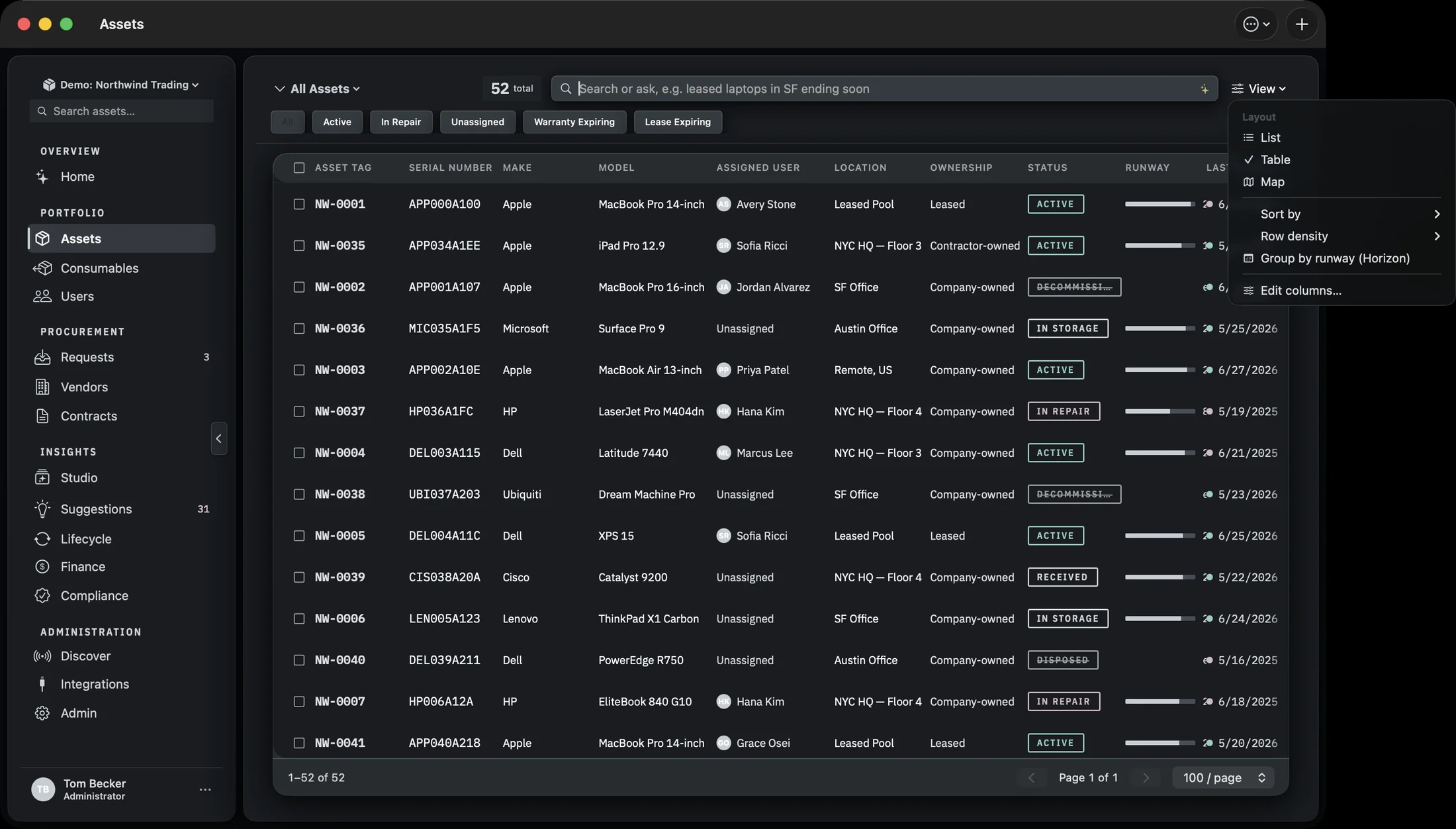
- Layout. Table is the default and the one with columns. List is denser and reads better on a laptop screen. Map plots the same rows the table would have shown, filters included.
- Sort by and Row density do what they say, and both are remembered.
- Group by runway (Horizon) breaks the list into bands by how much planned life is left, which is the fastest way to see a refresh year coming.
- Edit columns is table-only. Around thirty columns are available, and any custom field you have defined appears as one automatically. Reordering, resizing and hiding are all remembered between launches, per person.
Reading a record
Activate a row and you get the machine: its instrument cluster at the top, then every section that has something to say about it.
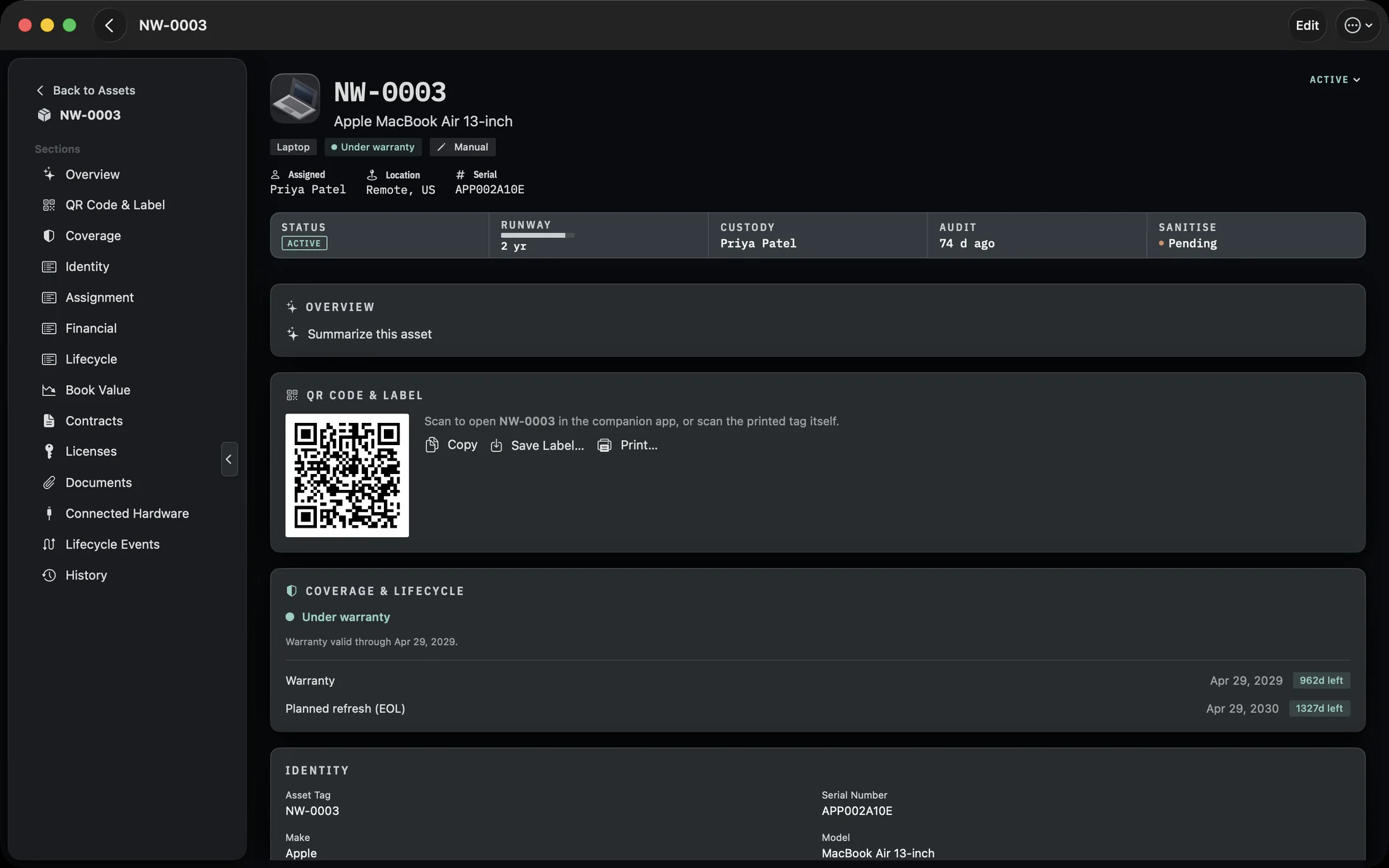
The rail runs Overview, QR Code & Label, Coverage, Identity, Assignment, Financial, Lifecycle, Book Value, Contracts, Licenses, Documents, Connected Hardware, Lifecycle Events and History. A section that has nothing in it is still listed, which is deliberate: an empty Documents section is information, and hiding it would make the gap invisible.
QR Code & Label is worth knowing about early. Every asset has a code that opens this record in the companion app, and the same card will print a label or save one. History at the bottom is the audit trail for this machine alone: who changed what, and when.
Adding assets
Four ways in, and they are on one sheet because the right one depends on what you are holding.
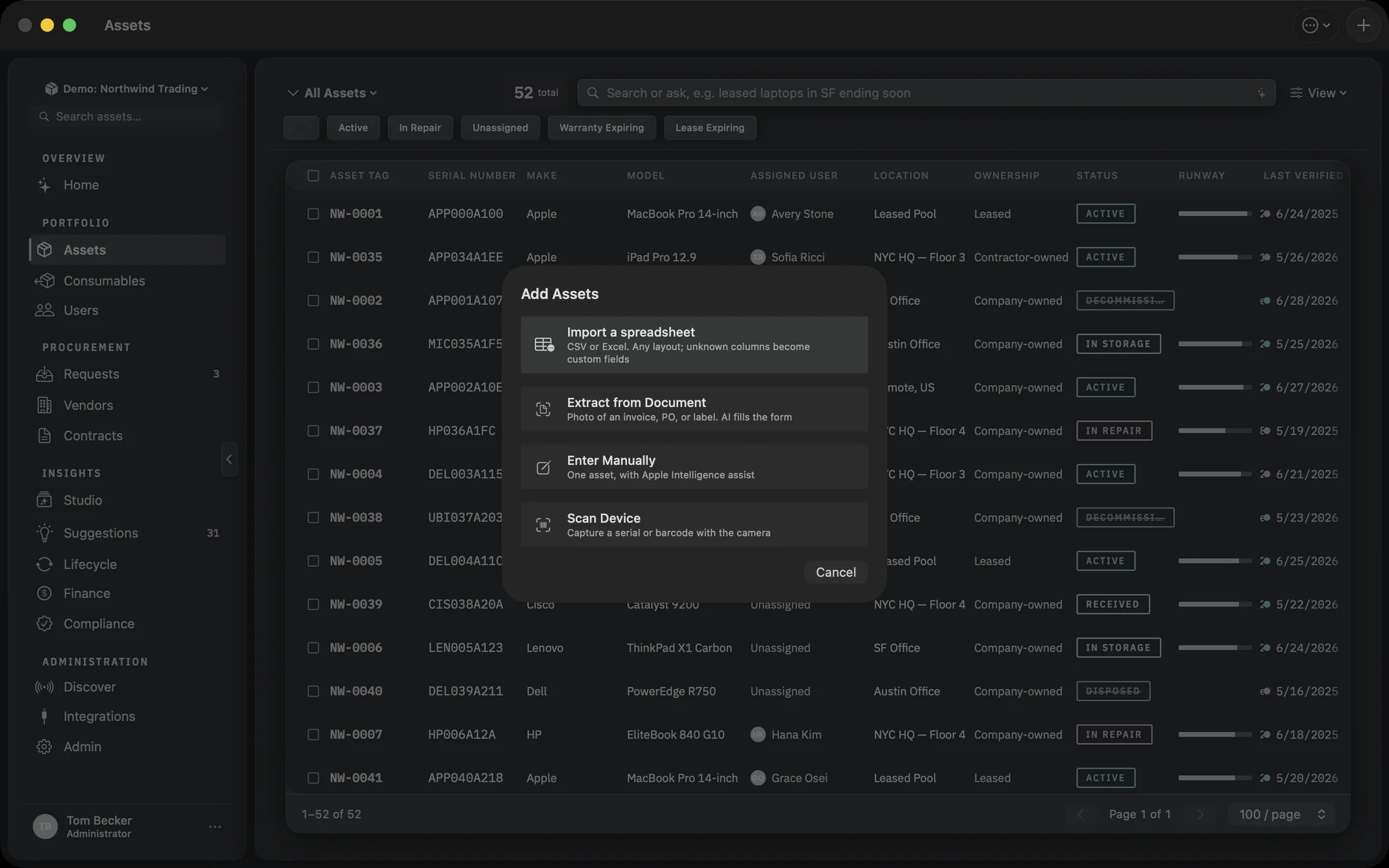
Import a spreadsheet
CSV or Excel. You do not have to reshape the file first: columns are matched on their values as well as their headers, so a column called Who full of names is recognised as an assignee. Columns that are yours alone become typed custom fields instead of being dropped.
Extract from Document
Point it at a photo or scan of an invoice, a packing list or an asset label. The text is read on the Mac, the fields are pulled out, and the intake form opens filled in for you to check.
Enter Manually
One asset, with Manifest suggesting as you go.
Scan Device
A serial or barcode through the camera, which is the receiving-desk path: a delivery, a box, a machine at a time.
Doing it to two hundred at once
Tick anything and a bar appears along the bottom. It is the same bar in every layout, and it is the only mode switch left.
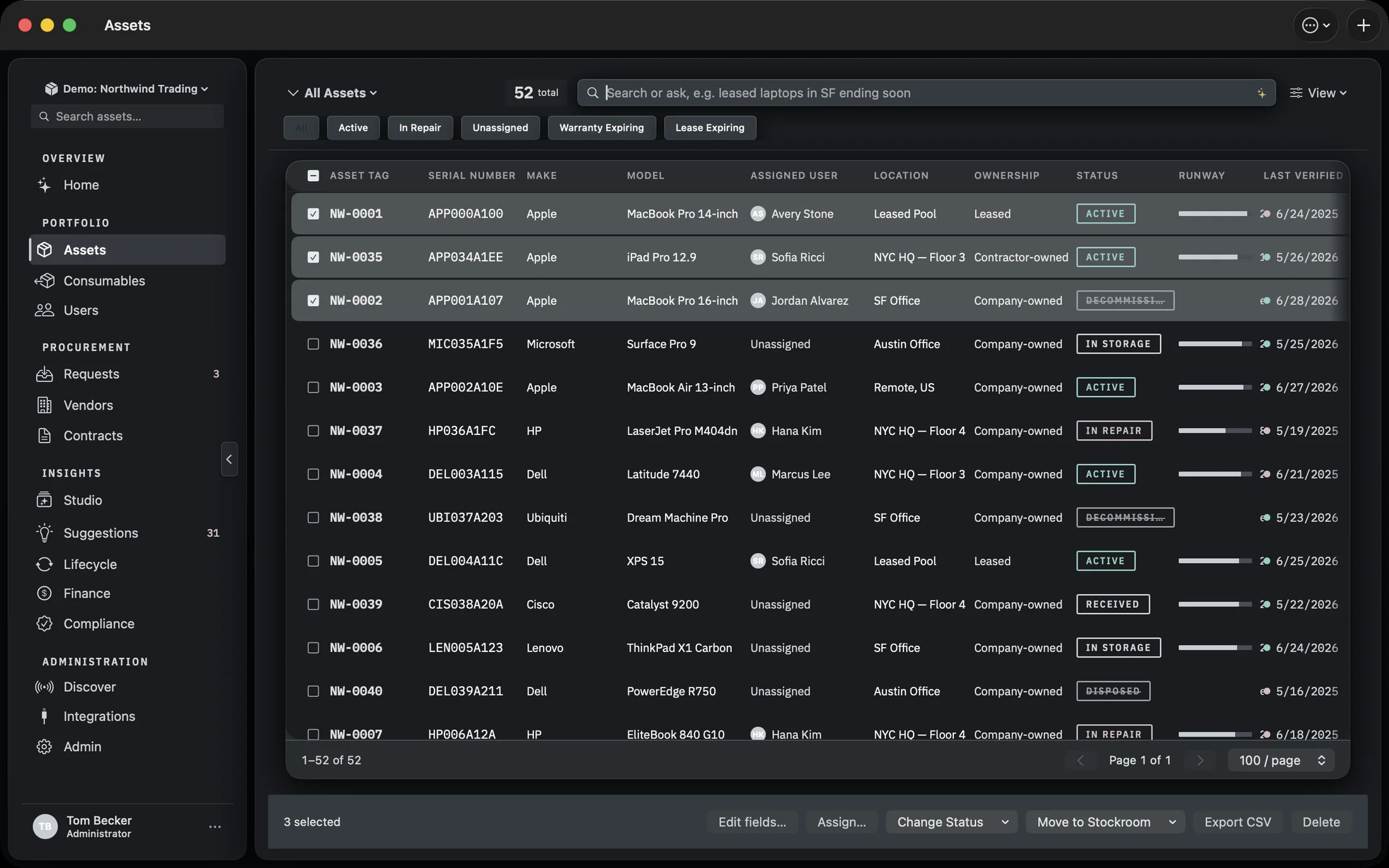
- Edit fields sets any field across the selection at once.
- Assign hands them all to one person.
- Change Status offers only the statuses that are safe to change in bulk.
- Move to Stockroom lists the stockrooms defined in Admin, and can also take machines out of one.
- Export CSV writes out exactly the selection, not the page.
- Delete is a soft delete. The assets are hidden and their audit trail is kept, because a machine that existed still happened.
Disposed is deliberately not in the bulk list. Retiring two hundred machines in a click would produce two hundred records with no account of how they left, and the account is the thing an auditor asks for. Disposal is per asset because the evidence is per asset. See Retiring a machine.
Turning a view into something you can send
The current filter is already a question. The More menu turns it into an answer somebody else can read.
Dashboard from this view and Report from this view both hand the Studio whatever the table is currently showing, described in words: the question you asked, or the search you typed, or the chip you clicked. You are not rebuilding the filter at the other end.
The same menu holds Alerts, with a count when any are open, and Select Multiple for people who would rather not click checkboxes.