Admin
Admin is where the workspace is configured rather than used: what people can request, what models you hold, where spares live, which extra fields exist, what gets watched, and how the whole database is backed up.
- For
- Configure the workspace: request catalog, models, stockrooms, custom fields, automations, Home panels and backup.
- Will not
- Automation rules are only checked while Starkive is open; there is no background service, so anything a rule would have caught is announced next time you are in the app.
- Writes
- Changes settings, catalog, models, stockrooms, fields, rules and Home layout; every write lands in the append-only Activity Log, which is not edited or removed.
The tab row
Admin is one screen with ten tabs across the top. They wrap rather than scroll, so the last one is never off the edge.
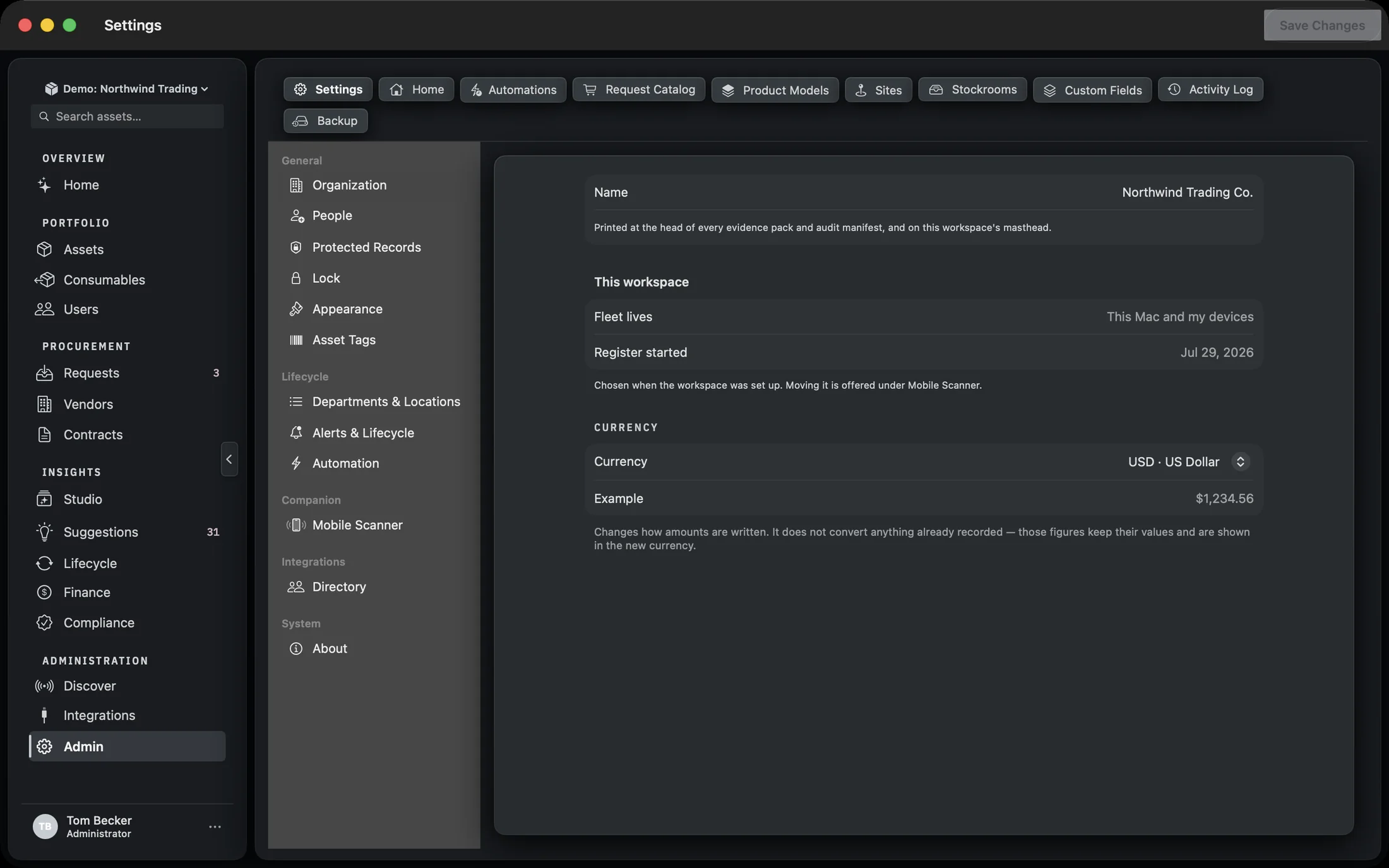
⌘, relies on: the shortcut navigates to Admin and expects to land here.The tabs are Settings, Home, Automations, Request Catalog, Product Models, Sites, Stockrooms, Custom Fields, Activity Log and Backup. Each is a plain button rather than a segmented control, which is why the row wraps instead of clipping when the window is narrow.
Other parts of the app can send you to a specific tab. When they do, Admin opens on that tab rather than Settings.
Automations
A rule watches one thing the workspace can prove and announces it once. It is not a workflow engine, and the screen says so.
New Rule opens a sheet with four sections. Trigger is the event and, for events that use one, a day window. Then is a single toggle, Show a notification. Webhook takes an https URL and tells you what it detected, Slack, Teams or a generic JSON endpoint. Email to takes people from the directory, stored by id so the rule keeps reaching them if their address changes, plus a free-text field for addresses that are not in the directory.
Rules are checked while Starkive is open. There is no background service, so anything a rule would have caught is announced the next time you are in the app. The screen states this above the list rather than leaving you to discover it.
Check now evaluates immediately instead of waiting for the next sweep, which is the only way to know a rule you just wrote matches anything. It runs the same path the scheduled sweep runs, so testing a rule does not consume it. The result is reported in words: Nothing new to report. or Announced 3 items.
Under the rules, Recent activity lists the last twelve firings with an envelope or a bell to show whether each one was emailed, and when it fired.
Request Catalog
What a user can ask for, and what happens when they ask. Everything active here appears in the request flow.
New Request Type opens an editor with three sections. Details is title, summary, category and an Active, appears in the request flow toggle. Fulfillment is what the request is fulfilled by, the SLA in days, and whether it requires approval. If it does, you can add Auto-approve under a cost with a threshold. Questions is the fields the requester fills in, each with a type and a required flag; a choice question takes its options comma-separated.
Deactivating a request type retires it without deleting its history. The row stays in the list, marked Inactive, and stops appearing in the request flow.
Question keys are derived from the question label and are stable across launches. Answers are stored against the key, so a key that changed between launches would leave saved answers unable to find their question. The editor fills in a key for you when you leave it blank.
Product Models
The normalised make and model library. Specs, useful life, warranty and end-of-life live here once, and assets reference them.
Seed from assets walks your existing register and creates a catalog entry for every distinct make and model it finds, so you do not type a fleet in by hand. It reports what it did: Added 14 models from your assets. or Catalog already covers your assets.
Each row shows the model, its category, useful life in months, warranty in months, end-of-life date where set, and a count of how many assets reference it. New Model takes manufacturer, model, category, SKU, useful life, warranty, end-of-life and end-of-support dates, and notes. Only manufacturer and model are required.
Stockrooms
The places spare and undeployed hardware lives: your office, a client site, a vault.
Each stockroom has a name, a kind, a location and notes, and an Active toggle. The row shows the kind, the location where set, and how many assets are currently in it.
Assets are put into a stockroom from the asset editor, or in bulk from the Assets list’s Move to Stockroom action, which lists the stockrooms defined here and can also take machines out of one. Deleting a stockroom detaches its assets rather than removing them.
Custom Fields
The extra attributes you attach to users and assets beyond the built-in schema. One tab, two entities, a segmented control between them.
A field has a name, a type, and, for a choice field, its options one per line. User fields can additionally take a Directory attribute, for example costCenter or extensionAttribute3. Leave it blank for manual entry.
Deactivating a field hides it without deleting the values already stored against it. The key of an existing field is stable, which is what keeps those stored values matching their field.
Home
Which panels appear on the Home screen, and in what order. In an asset system the operator decides which numbers matter, so almost everything here can be turned off or moved.
Panels are grouped by where they sit: Main column, Side column and Bottom band. Each row has up and down controls and a visibility toggle. A panel only ever moves within its own column, so Home’s two-column composition survives any arrangement. Changes apply the next time Home opens.
Reset to default puts the layout back, and is disabled while the layout is already the default.
Below the fixed panels is Your charts: any widget you have built in Studio, offered as a Home panel with Add to Home. This is what makes the set of Home panels open-ended rather than the fixed list that ships. If you have no saved charts yet, the section says so and points you at Insights → Studio.
Backup
Everything stays on this Mac. A backup is a single compressed file you save wherever you like, and restore from after a crash or on a new machine.
- Back Up Now… writes every workspace and all records to one
.starkivefile. Nothing is uploaded. - Restore from Backup… replaces all current data and restarts the app to finish. It asks first, naming the backup’s date and version, and warns that it cannot be undone.
- iCloud backup keeps a complete backup, every workspace, all records and your uploaded documents and photos, in your private iCloud, so you can restore on any Mac signed into the same account. It can run automatically on quit and daily, and Restore from iCloud… lists the snapshots with their dates and sizes.
A backup made by a newer version of Starkive Manifest will not restore into an older one. The app says so and tells you to update first, rather than failing halfway through replacing your data.
Export Evidence Pack… builds one .zip an auditor can open anywhere: the full inventory, the complete audit trail, IMAC history, the overdue-verification and unacknowledged-assignment worklists, and every sanitisation certificate on file, with a summary mapping each to its standard. It is a standard zip rather than the .starkive format, deliberately, so it opens on a machine that has never seen this app.
When a compliance profile has been captured, the pack also includes the compliance-depth registers: regulatory scope, encryption, acceptable-use attestation, fixed assets, disposal chain of custody, and, where there are any, the incident register and breach notification log. The README counts only what actually landed in the pack, so its certificate count never overstates what you are handing over.
Activity Log
The append-only record of what changed in the workspace, and who changed it. It is the same trail the evidence pack exports.
Every write to the register lands here. The log is append-only by design: entries are not edited or removed, which is what makes it usable as evidence rather than as a convenience. Per-asset history is the same trail filtered to one machine, and is reachable from that asset’s record.
The evidence pack exports this in full as audit-trail.csv, alongside imac-history.csv for install, move, add and change events.