DocumentationiPhone
Assets
On the phone, Assets is the register itself. It opens on the list rather than on a menu, and everything you do to a machine happens from a row in it.
- For
- The register on the phone: browse assets, people and consumables, and open a record to verify, flag or edit it.
- Will not
- Disposal is not on the phone: it needs a method, date, sanitisation evidence and often a witness. A removed record cannot be edited.
- Writes
- Edits are staged until Save, then written as one audited change; Cancel leaves no trace. Delete marks the record removed on every device and keeps its history.
The tab opens on the register
Three collections sit side by side under the title, and the one you almost always want is already showing.
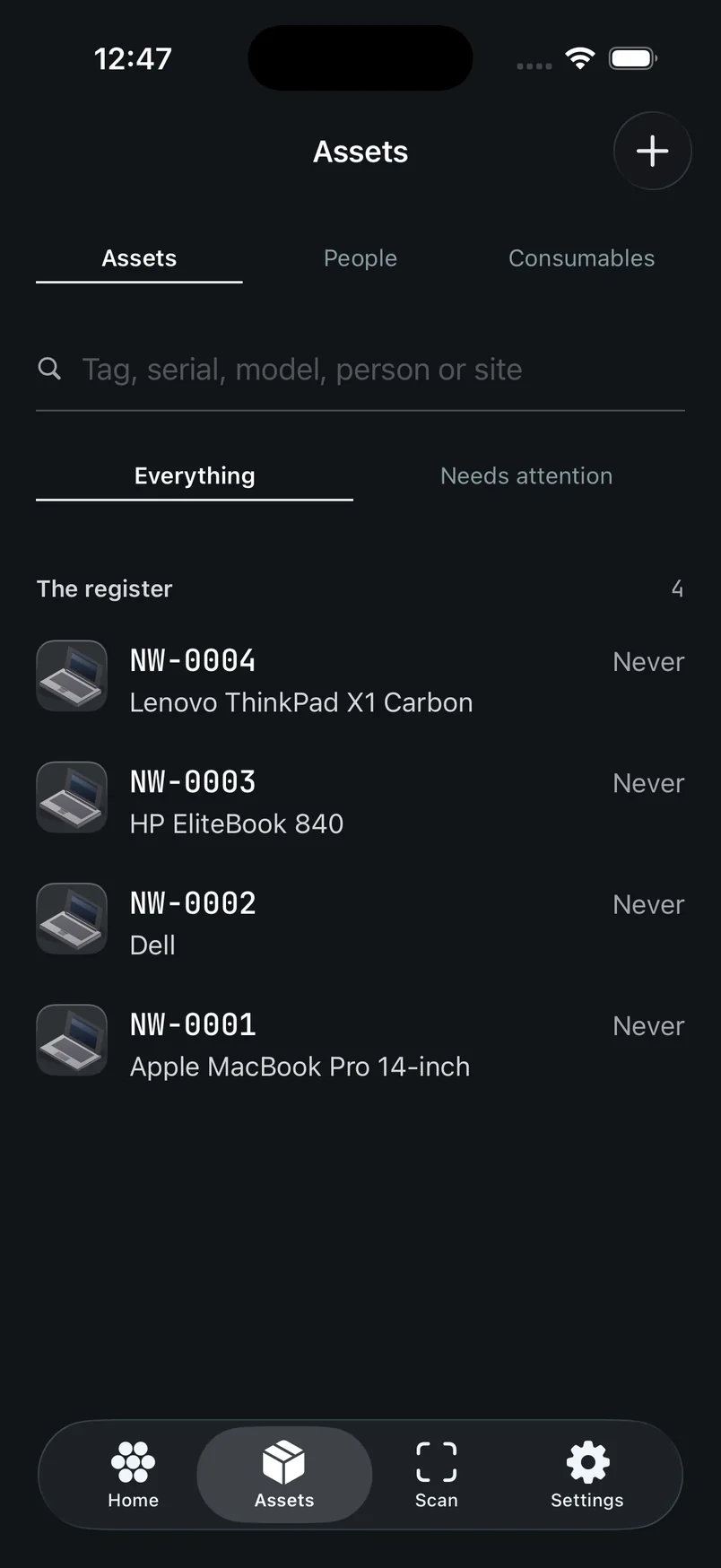
The three are siblings, not destinations behind a signpost. A segment is one tap from any of the others, and nothing here pushes a screen whose only content is the name of the thing you were trying to reach.
People is the one collection that pushes: tapping a person opens their record, because a person is a different object from the register you were reading.
Reading a row
Each row answers three questions in order: which machine, what it is, and what is wrong with it.
The third line shows a fault when there is one: Flagged for audit, In repair, or Disk not encrypted on an active machine. When there is no fault it falls back to the assigned user, then to the site, and then to nothing at all.
The age is Never when a machine has no verification on record. That is a word rather than a number on purpose: a record with no sighting has no age, and rendering one would be the register inventing a verification that did not happen.
A removed record drops the age and the fault entirely and shows who removed it and when instead. Reporting a stale verification about a record that is gone would be answering a question nobody asked.
Filtering the list
A filter box appears once the list is long enough to need one.
The field is labelled Filter and matches against the name and the supporting line of each row, so a search finds a machine by its tag, its model, or the person holding it. It appears when the collection holds more than eight rows.
When nothing matches, the empty state says Nothing matches “…”. with the term you typed. That is deliberately different from the empty state a collection shows when it genuinely holds nothing, because somebody chasing a sync problem that is really a typo is an afternoon gone.
Opening a record
Tap a row and the record grows out of it. The whole asset is there, but never all at once.
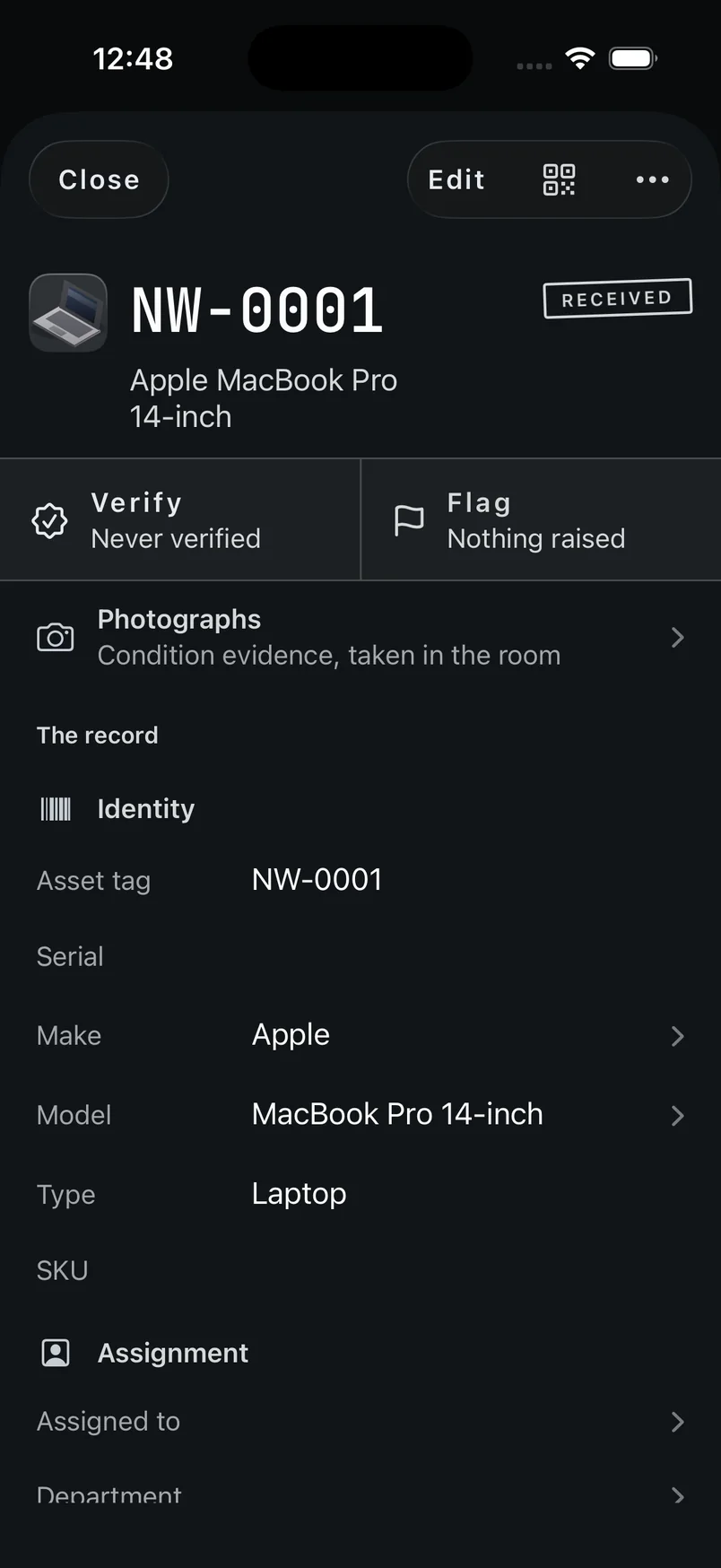
The record is one scroll rather than a set of folders you have to open. Each group carries a summary line on its spine, so you can see whether anything inside is wrong without opening it: a lapsed warranty, an unencrypted disk, a verification that is overdue.
Verify stamps the record with the current date and shows how long ago the last one was: Verified today, Verified yesterday, Verified 42 days ago, or Never verified. Flag raises the record for audit, and reads Flagged once it is.
The groups are Identity, Assignment, Location, Condition, Lifecycle, Finance, Network & disk and Regulated data. Below them sit Photographs and History, which are not field groups: nothing in either can be changed.
Editing a record
Nothing is written until you press Save, and the bar that saves it rides every level of the record.
Press Edit
The button is in the top right of the record. It opens a session; nothing on the screen is written until you save.
Tap a value to change it
Tapping a field opens the right control for it: a keyboard for free text, a calendar for a date, a list for a person or a site. There is no separate mode to enter first.
Press Save
The bar counts what is staged. One save writes them all as a single change in the audit trail, so the log reads as one decision rather than four unconnected edits.
Cancel asks before discarding when there is something to lose, and says how many changes are staged. A session that ends in Cancel leaves no trace, because an audit entry for a change that never happened is worse than no entry.
Disposal is not on the phone. It needs a method, a date, sanitisation evidence and often a witness, which is a desk job rather than something to stamp while standing at a rack. The status stamps offer only the statuses that are safe to change from here.
Reading an invoice
Price, vendor, PO and dates come off a piece of paper, and typing them one-handed in a rack aisle is why they stayed empty.
The overflow menu on a record holds Read an invoice, which opens the document camera. Point it at an invoice, a packing list or an asset label, and the text is read on the device. The fields it finds are staged into the open session for you to check, so you can drop one you disagree with before anything is written.
The review sheet is presented even when nothing was found, so a page that could not be read says so. Returning silently to the record would read as the camera having failed, and you would try again with the same photograph.
Read an invoice is hidden on a device with no document camera, such as the simulator. An action that opens a black rectangle is worse than one that is not offered, and every field it fills is typeable anyway.
Removing a record
Delete is for a record that should not exist. It is not how a machine leaves the organisation.
Delete record is in the overflow menu. It asks for confirmation, and the confirmation says where the record goes: it is marked removed on every device, and its history is kept. The phone has a Removed filter, and the record keeps a banner naming who removed it and when.
Use it for a double scan, a wrong tag, or a record that should never have been created. If the machine was actually disposed of, do not delete it: set its status to Decommissioned and photograph the certificate on the record, which files it against the asset. Recording the full disposal, with the witness and the sanitisation method, is not on the phone yet.
A record that has been removed cannot be edited. Scanning the sticker on a machine retired last year opens the record with its banner and no Edit button, because editing it would write to a row the register has already accounted for.
Consumables
The third collection is the shelf, and it behaves differently from the register.
Each row leads with the count, because that is the question being asked in front of a shelf: 12 reams · A4 paper. A row at or below its reorder point is flagged, and the supporting line reads At or below the reorder point.
The + in the toolbar adds a consumable, and it is only offered on a phone that owns its register. A companion holding a replica of a Mac’s register has no way to send a row it invents, so a consumable typed there would sit on one device while the stockroom it claims to describe knows nothing about it.
Deleting a consumable asks first, and the confirmation is worded so nobody can read it as tidying their own handset: it removes the row from every device in the organisation, not just this one.