DocumentationiPhone
Home
Home is the first screen on the iPhone companion. It does not list the fleet: it lists what is asking for something, because an overview that shows everything has not overviewed anything.
- For
- The iPhone companion’s opening screen, showing what is asking for something and what the Mac noticed.
- Will not
- It does not list the fleet, show your assets, greet you by name, or animate the figures. These omissions are deliberate: Portfolio lists the fleet, and an operator is an admin rather than a holder.
What you are looking at
Two movements and a prologue. The anatomy is fixed, so the screen reads the same on every launch and only the contents move.
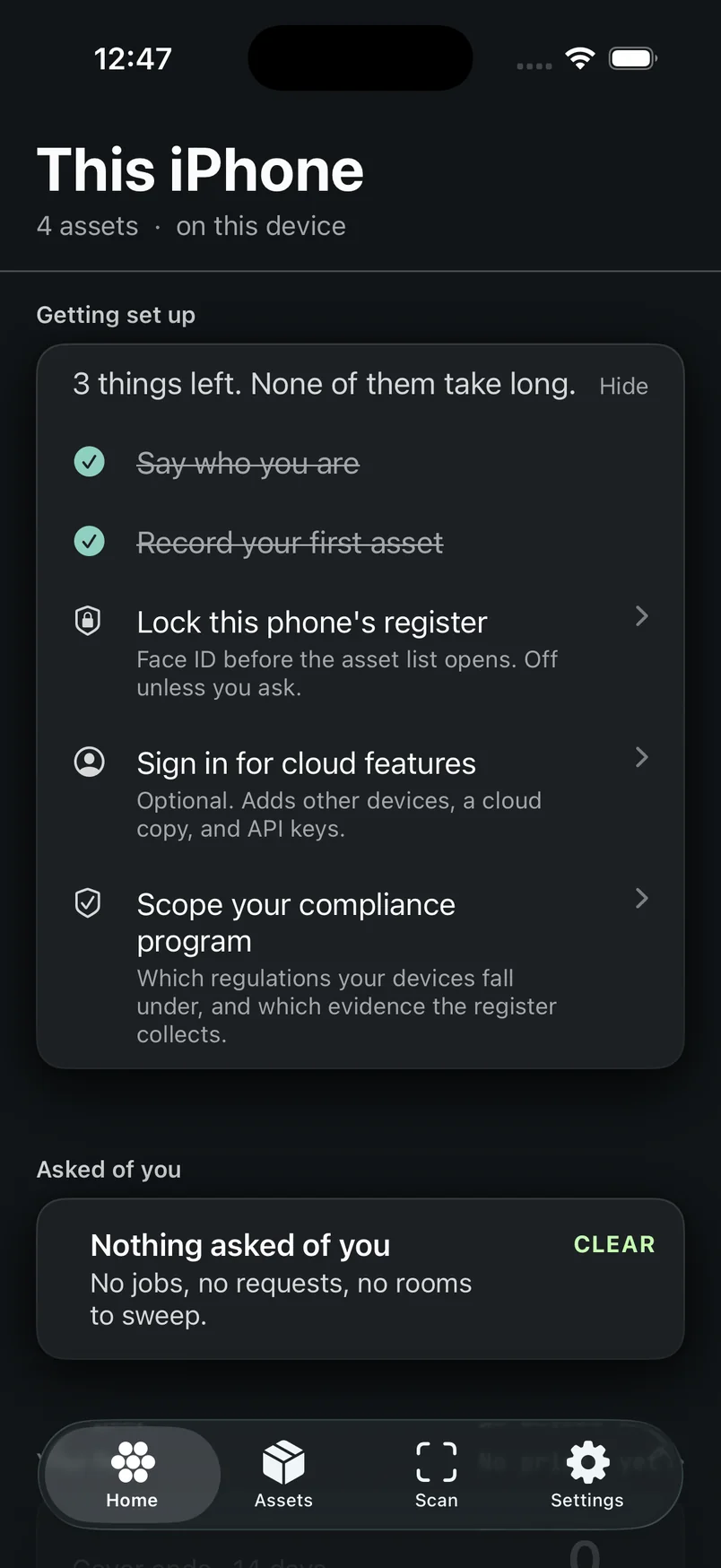
The screen is built from three kinds of thing, and the rebuild that produced the current layout separated them on purpose. The prologue is the instrument reporting on itself: sync trouble, the setup checklist, a scanned tag that matched nothing. Asked of you is work addressed to a person.Your fleet is the register reporting on the fleet.
Ten of the eleven decks that used to sit here were conditional, so the silhouette changed daily and urgency was carried by position in the stack. Both bands now render on every launch, and a movement with nothing in it says so rather than vanishing.
The masthead
Three lines: where the register comes from, how many assets it holds, and whether the reading is current.
The first line names the source, not the device. A phone paired to a Mac shows the Mac’s name with .local stripped. A phone signed in to Starkive Cloud shows Starkive Cloud. A phone holding its own register shows This iPhone. The distinction matters because a standalone phone is not a window onto a Mac, and titling it with a Mac’s hostname would put a machine’s name over a fleet it has never seen.
The standing line is one of held, syncing, on this device, signed in, synced with a time, not reachable or offline. A standalone phone reads on this device rather than offline, because there is nothing to be offline from and an amber fault lamp that is always on is one nobody reads. A signed-in cloud phone reads signed in or synced, never offline, for the same reason.
A sync from today reads as a time, 14:32. An older one carries its day, Mon 09:15. The formatter used to be flat, so yesterday afternoon and this afternoon were the same six characters on the one line somebody checks to find out whether the fleet in front of them is current.
The prologue
Three decks at most, and the cap is the rule. A bunch of things is what happens when every new feature earns a deck here.
- Sync incomplete appears when the fleet reports trouble, unless the setup card is already on screen and undismissed. The two of them are the only places that can tell you the change history is not moving, and exactly one of them should.
- Not sent appears when this device is holding work it could not deliver. The sentence is either “One change was refused and will not be retried on its own.” or the same with a count. Try again resends it.
- Not on this device appears when a scanned tag matched nothing. It offers Ask again (sync, then look once more) when there is a connection, Add it to take the machine into the register, and Dismiss.
The Not sent deck sits with the sync note rather than under Asked of you because nobody asked: the phone refused it. Work that was assigned to you is a different thing and lives in the band below.
Asked of you
Three kinds of work, one band, and a title chosen to survive the weakest of them.
Jobs waiting opens the queue. The detail line names the nearest job rather than counting them twice, so a strip that would otherwise read “3 jobs waiting · 3 jobs waiting” says Including and the title of the first.
Requests waiting opens the waiting requests. Its detail line says what the requests are waiting for, which is not the same question as how many there are: All decided. Waiting on hardware to be issued., One needs a decision., or a count. An approved request still counts as waiting, because nothing has been issued, but it needs a storekeeper rather than an approver.
Sweep rows list the three most overdue stockrooms, worst first. Never swept sorts above longest ago, because never is a different statement. The status reads Never or Sweep, and the detail line reads No sweep on record, Swept today, or Last swept with a day count. Tapping one opens the scanner.
The word is Sweep, never audit and never verify. A camera panned down an aisle establishes that a label was in a room, and the compliance word is the attestation it refuses to make.
When there is nothing in the band, it still draws. Nothing asked of you with the detail No jobs, no requests, no rooms to sweep., or a count of jobs reported done recently. That second sentence is fleet-wide rather than yours, so it says reported rather than claiming you did it.
Your fleet
Five readouts, each a full-width line, each opening the population it counts.
- Cover ends · 14 days counts assets whose cover ends inside the fortnight. The window is interpolated from one constant, so the label, the tally and the drill-down all read the same number.
- Out of warranty counts assets that have already crossed.
- In repair counts assets currently in that state.
- On nobody counts unassigned assets.
- Flagged counts assets flagged for audit.
A readout at zero still draws, so the five positions never move and a thumb can learn them, but it is not tappable. A tappable nought opens an empty list, which reads as the app failing rather than as good news.
The band used to be titled Crossing a line · 14 days over all four figures. Only the first is a fortnight fact: out of warranty has already crossed, and in repair and unassigned are states with no time dimension at all. A thing does not become unassigned in fourteen days. The window now hangs on the one figure that owns it.
The trailing figure is the recorded cost: the purchase prices in the register, added up. It is not depreciated, and it is not a book value. A depreciated figure needs a useful life on every asset, and that is a Mac number. Finance, which this figure opens, gives it the same name.
It is unconditional. A register where nobody has typed a price reads No prices yet rather than hiding the door, because Home is Finance’s only caller and a hidden door is a screen nobody can reach. Nothing recorded is spelled out rather than printed as £0, which would be a claim the register cannot make.
New devices
Taken this fortnight and still short of a holder or a warranty date. Collapses to nothing when there is nothing to finish.
This deck is content inside a band that does not collapse, so it is allowed to disappear when there is nothing to finish. The three rows are the most recent arrivals that are still incomplete, and the detail line on each names what is missing rather than saying the record is incomplete.
When nothing is recorded
One question, two answers, and neither band draws.
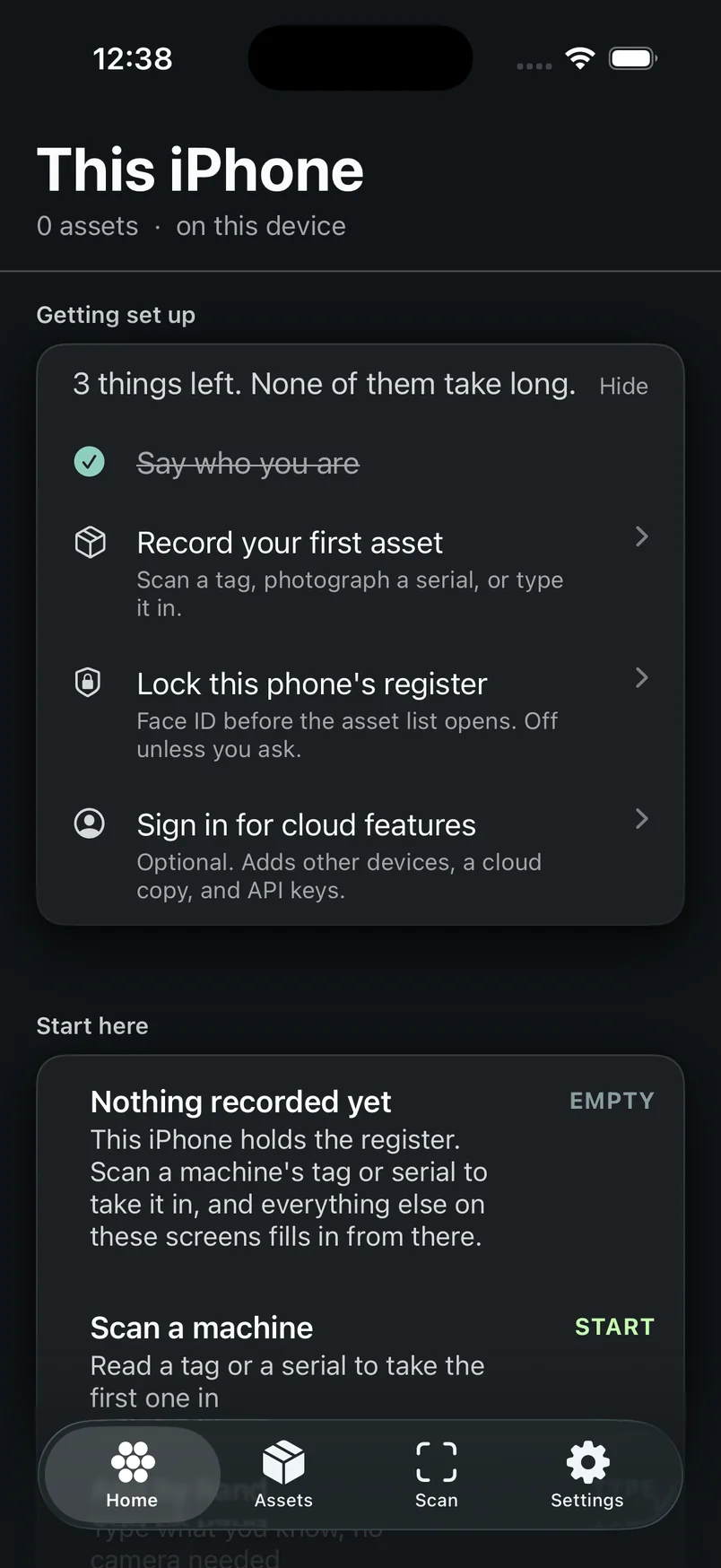
With nothing recorded, the honest thing to know about the fleet is that there isn’t one yet. Scan a machine opens the scanner. Add by hand opens the manual intake, no camera needed.
The advice line reads differently depending on the mode. On a cloud register it says nothing has arrived yet and that a register already in Starkive Cloud will appear at the next sync. On a standalone phone it says this iPhone holds the register. On a paired phone with nothing synced it says nothing has arrived from the Mac yet.
What Home does not do
The omissions are deliberate, and they are the fastest way to know whether you are on the right screen.
- It does not list the fleet. That is Portfolio’s job. Home lists what is asking for something.
- It does not show your assets. There is no operator-to-assets query anywhere in the product. Assets carry holders, and the operator is an admin rather than a holder, so a row reading “your assets” would be fabricated rather than merely imprecise.
- It does not greet you by name. The operator name is optional, and a greeting rendered from a nil is how a premium tool starts reading as a template.
- It does not animate the figures. Motion is keyed on whether a row is there, never on a value. An interpolated total implies the intermediate figures were once true, and an auditor reads these pixels as evidence.
The attention list and the tiles below it are two different scopes on one screen. The list is derived from the rows held on this device, which are capped. The figures are whole-register counts. The narrower one says so rather than implying otherwise.