DocumentationiPhone
Settings
Settings on the iPhone is an index of places, not a form. Each row names an area, says the one thing worth knowing without opening it, and holds the controls behind it.
- For
- An index of places on the iPhone, each row naming an area and its standing.
- Will not
- No iCloud Sync toggle, no Data Residency warning, and no Done button. Settings is a tab root, and the removed controls either did nothing or could not be honoured.
- On iPhone
- The account deletion screen is shared with the Mac, so one set of words describes one irreversible act.
An index, not a pile
The first screen answers “where do I go” in one glance. The controls live where they belong, one tap in.
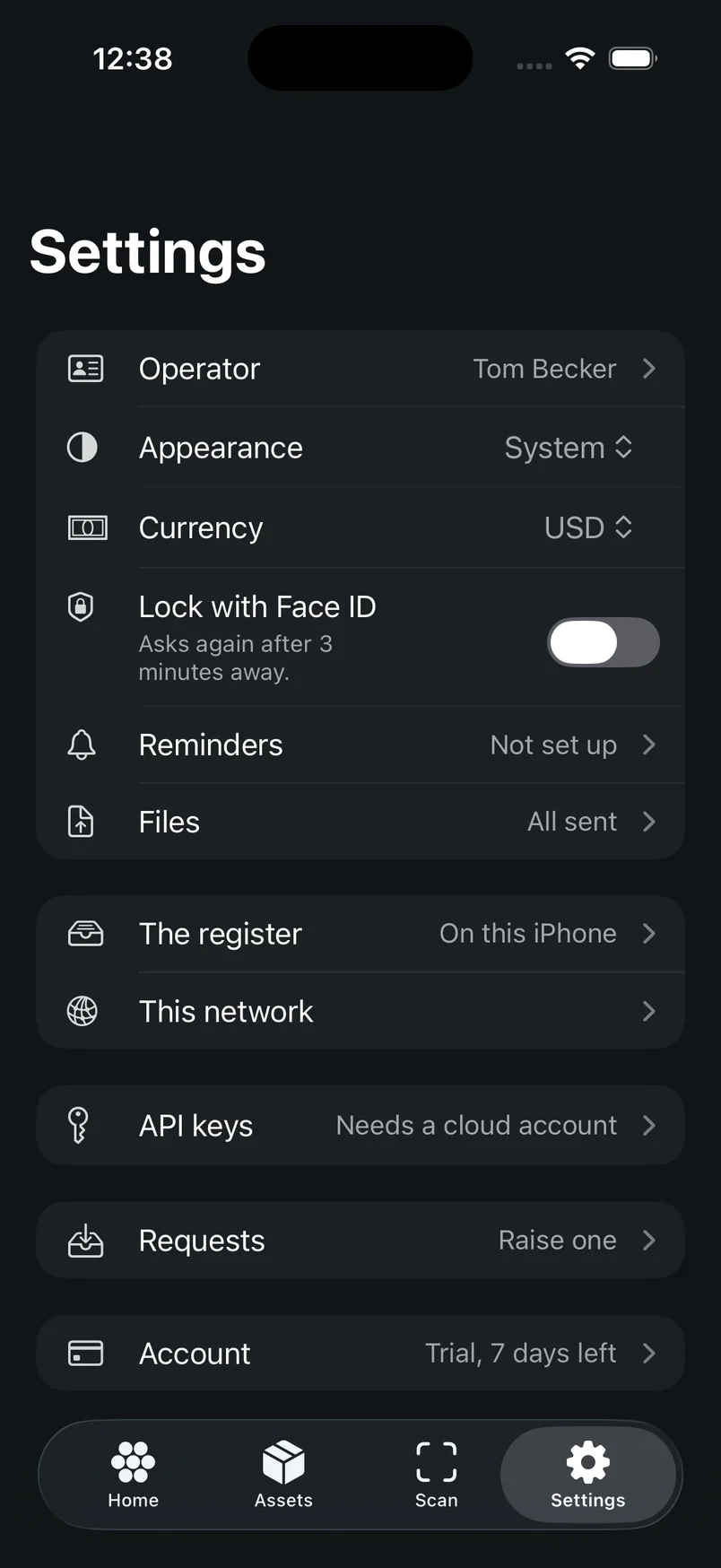
Settings used to be one long scroll of every control the app has. It is now a list of places, grouped by the four questions above, with the controls behind the rows that own them. The grouping did not change; what changed is that the answer to “where do I go” fits on one screen without scrolling.
A row carries a standing on its right where there is one worth seeing without opening it: who this phone signs as, whether it is locked, which plan is running, how many requests are waiting. The standing is read off the same values the screen behind it shows, so it cannot disagree with what you find when you tap through.
Two rows are the control rather than a door to it. Appearance and Currency are menus that open under the thumb, because the whole answer fits there and the current value is already printed on the right. A row that pushes a screen holding one switch is a door to a cupboard containing a door.
This handset
The first group is about the phone in your pocket: who it signs as, how it looks, what it costs in, whether it locks, what it tells you about, and what is still on it.
- Operator. The name every edit, sighting and intake on this phone is signed with. The row says Not set until you name one, and the screen behind it explains that work is signed as an unnamed operator until you do.
- Appearance. A menu of the three options, shared with the Mac so the words do not drift. Setup asks for it on step one; this is where you change your answer.
- Currency. The code, not the symbol, because USD and CAD both wear
$. Changing it re-labels amounts rather than converting them, which is why the picker prints an example rather than only a code. - Lock with Face ID (or whichever method this handset uses). One switch, on the row. Disabled and explained when the handset has no passcode: a greyed switch with nothing beside it reads as a fault rather than a prerequisite.
- Reminders. Warranties ending and verifications falling due. The row says Nothing due, 3 scheduled, Off or Not set up, so you do not have to open it to find out.
- Files. What is still on this phone. A blocked upload is a photograph of a serial that never left the handset, and nobody discovers that until they go looking for it on another device, so the count is on the row.
The register
Where this phone’s asset records live, how it was set up, and what it can reach on the network.
The connection line names the situation rather than the device. A paired phone reads Connected to the Mac or The Mac isn’t on this network; a cloud phone reads Signed in to Starkive Cloud or Not signed in; a phone standing alone reads The register is on this iPhone with the line Everything works here, with or without a connection. The word “Disconnected” is not used, because it describes the phone rather than the situation and there is no route on which that is the useful thing to say.
Unpair sits on the connection card when a Mac is paired. It asks first, and the dialog names what goes: the number of edits that have not reached the Mac, the number of photographs that have not been sent, and the fact that anything recorded only on this iPhone goes with it. It never says “nothing is lost”, because it cannot know that.
Provisioning walks the setup questions again: where the register lives, who it is for, and the regulated data it covers. Your answers come back as you left them, and what you have recorded stays. The one exception is named on the card: moving the register somewhere else leaves its old copy behind.
Move to Starkive Cloud appears when this phone owns rows worth moving. It names the step that is missing rather than the one you have already done: the plan, the account, the organisation keys, or ready. The order is forced by the cloud admission, not chosen here.
Other devices holds the pairing form, the list of Macs advertising themselves nearby, and the networks this phone has been authorised to scan. API keys is visible even when it does not apply, with the standing Needs a cloud account, because hiding it teaches somebody the feature does not exist.
Pairing with a Mac
The form is on the Other devices screen, and it says what went wrong when it does.
Open Settings → Mobile Scanner on the Mac
The Mac shows a six-digit code and a four-digit check beneath it.
Type both on the phone
The code goes in the first field, the check in the second. The device name is what the Mac will call this handset.
Tap Pair
If it does not work, the reason appears under the fields: no Mac on this network yet, a code that is not six digits, a check that is not four, or a code that was not accepted. Codes expire, so read a fresh one off the Mac.
A code cannot be typed at a Mac this phone cannot see. If no Mac is discovered, the form says so rather than inventing an address to send the request to.
Admins and Devices
Two rows that look similar and answer different questions. An invitation is about a person joining; an admission is about a phone being able to read.
Admins is where you invite somebody to sign in and hold a device. It is not the directory: the directory is called People and lives elsewhere, and running the two together is how somebody invites a colleague and assumes their handset is now trusted.
Devices is where a phone is let into the organisation’s encryption. It has three states, and the row says which one you are in: Not set up, Waiting to be let in, or admitted. The first device in a new organisation founds the key; every device after that waits for an approval from one that already holds it.
Both rows are visible even when the account has not founded an organisation yet, and both say so on the row. A row whose destination can be empty is a blank screen with a back button, so every branch renders something.
Requests, Vendors and Contracts
Records rather than settings, kept here because the alternative was a tab called More holding three rows a standalone phone never sees.
Requests is unconditional: this phone can raise one, and a row that appears only after the first one exists is an entrance nobody can use. The standing reads Raise one when the register is empty, 3 waiting when there are open requests, and All settled when there are none.
Vendors and Contracts appear only when this phone is holding some. They arrive by syncing down and a phone cannot create either, so an unconditional group would put two permanently empty rows reading “None yet” on a standalone register for ever.
Account and plan
The subscription this organisation is on, the way to sign in, the way to export the register, and the way to close the account.
The Plan card names the standing rather than always saying “View plans”: Your plan when licensed, Trial, 6 days left during the trial, See plans otherwise. It is reachable on any day of the trial, not only after the trial has ended, because a customer who skipped the tile during setup and later decided to pay needs a way back in.
Your register exports every asset on this iPhone as a CSV, through the share sheet. It works whatever the plan says and whether or not the trial has ended. A read-only trial is only defensible because the register is never collateral, and this is the button that makes that sentence true.
Sign in appears when this phone is not signed in, and names the act rather than the outcome: the outcome is the subtitle, Reach your register from anywhere, and keep a cloud copy. When signed in, the row becomes Signed in and opens the account screen, where the devices and signing out live.
Delete this account is last, only when signed in, and names the account it ends. It closes the account on the server and cannot be undone. The same screen is used from the Mac, so there is one set of words describing one irreversible act.
What is not here
Two things that used to be on this screen and are not, and one that is deliberately absent.
There is no iCloud Sync toggle. There was one, bound to a property nothing else in the app read, and flipping it did nothing. The name was wrong too: this product’s cloud is Starkive Cloud, on Supabase, and nothing syncs through iCloud. Where the register lives is chosen in setup and shown on the connection card, which is the honest place for it.
There is no Data Residency warning. It promised that LAN mode keeps data on-premises, which the screen could not honour with a dead toggle beside it, and it was framed in the on-/off-prem terms this product does not use for the two modes.
There is no Done button. Settings is a tab root rather than a sheet, and a dismiss control on a tab root either does nothing or drops you somewhere you did not ask to be.