DocumentationiPhone
First run on the phone
Setup on the iPhone is a short console of questions. It settles where the register lives, who signs the work, and what your labels will say, in that order, because that is the order of consequence.
- For
- Sets up the iPhone app: names the organisation, settles where the register lives, who signs work, and what labels say.
- Will not
- No spreadsheet import and no network discovery on the phone; its three routes are the three it has a camera and a keyboard for.
- Writes
- Nothing is committed until the last step; the signature is written first, then the profile and completion stamp in one transaction.
- On iPhone
- When the Mac app ships, There is a Mac already appears between the cards and pairs with a register on your local network.
What setup is for
The phone is not a scanner for the Mac. It can hold a register on its own, and setup has to work for somebody whose first device is the handset.
An admin who downloads the phone app first, as the first device in their company, must be able to finish setup from it: name the organisation, answer the regulated-data and framework questions, choose where the data lives, start the seven days and take a plan. Joining a Mac is one branch of this flow, not the whole of it.
Setup runs once. It is a full-screen console with a step track down the side, a masthead above the question, and a commit plate at the bottom. Back and Continue sit in the footer; Continue is live at every step and refuses in words rather than going grey, so a rule that blocks you is a rule you can read.
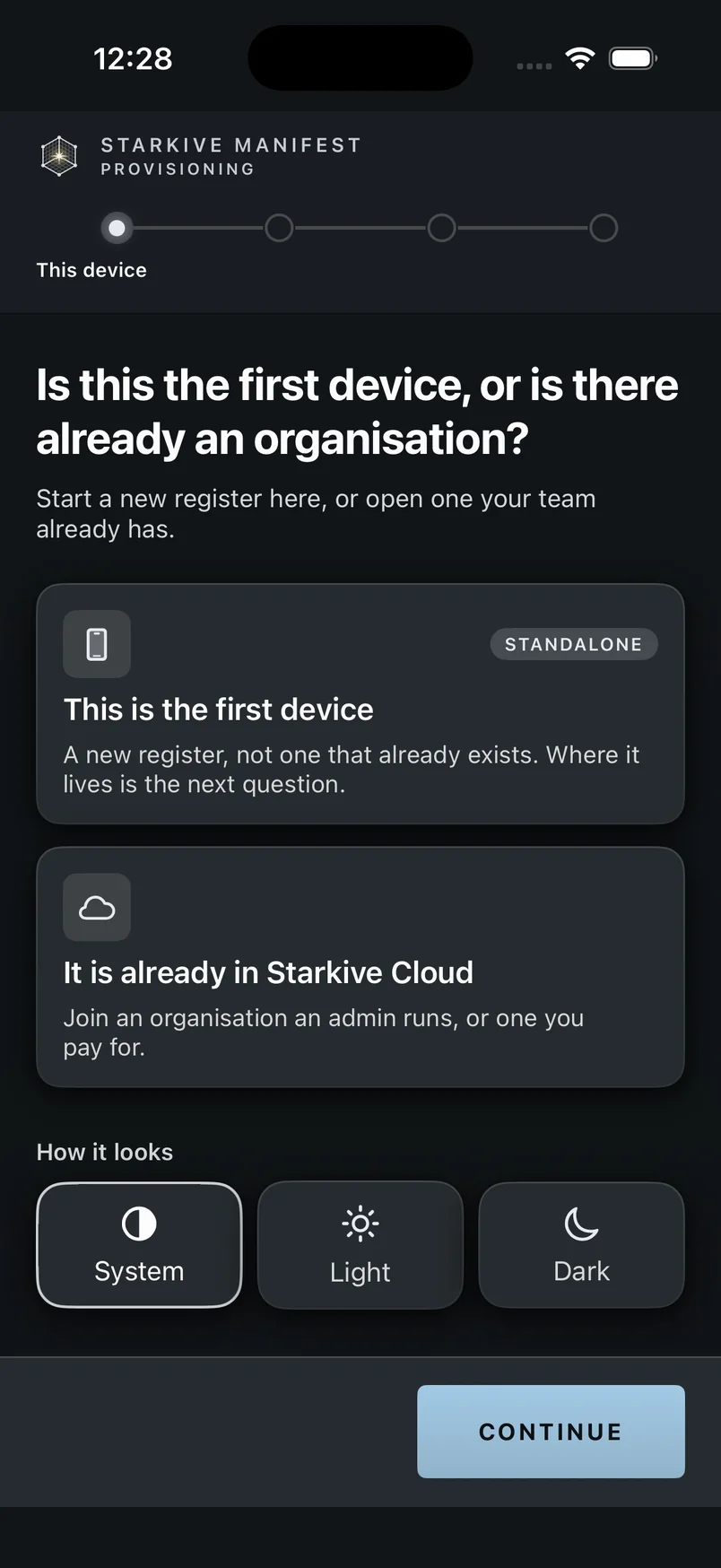
The first question
Is this the first device, or is there already an organisation? Everything after it depends on the answer.
Three cards, of which two are shown in this build. This is the first device starts a new register. It is already in Starkive Cloud joins an organisation an admin runs, or one you pay for. When the Mac app ships, There is a Mac already appears between them and pairs with a register on your local network.
The subtitle under the question is Start a new register here, or open one your team already has. It deliberately does not make the reversibility promise, because that promise is only true of one branch and belongs on the branch it is true of.
Below the cards sits LookChoice, the appearance control. It is on the first screen because it repaints the app immediately: chosen on screen four it would repaint three screens you have already walked.
Where the register lives
A separate question from the first one, and it was bundled into it until recently.
The masthead asks Who else needs this register? The subtitle is Where the register lives follows from your answer. The two options are drawn as a comparison, not as two tiles: ResidenceConsequences puts the options in its own header and compares them row by row.
The local column carries the reversibility promise in its Moving later cell: you can carry the register up to the cloud without re-entering anything. The cloud column states the opposite in the same slot, because moving back down does not exist.
The price is on the card, not one screen further in. Founding a cloud fleet needs an active plan, and saying so at the moment of choosing is the difference between an informed decision and a dead end discovered after committing to it.
Connecting
What this step offers depends on the route you chose, and the masthead follows what the screen is actually offering.
On the standalone route the title is Your seven days start now. Two tiles: Start the seven days, which says everything is unlocked and that on day seven the register goes READ-ONLY rather than locked, and Choose a plan now. The trial dates are drawn from the licence rather than computed locally, so the sentence here and the behaviour on day eight cannot drift.
On the cloud route the title is Sign in to Starkive Cloud for a joiner, and the founding stage’s own title for a founder. A founder who has just chosen the cloud has no account and no plan, so the plan comes before the account: create_org requires a consumed grant of kind purchase, and identity first cannot found a fleet.
Finish on this iPhone for now is the escape. It sets the residence answer to local and moves on, so the blurb — Sets up here and keeps the register on this phone. You can move it to the cloud whenever you like. — is literally true.
Who signs the work, and who the register is for
Two screens became one. Neither was a screen's worth on its own.
The masthead asks Who is this register for? The subtitle is Your name signs every change you record. The rest of it prints on the labels you stick on hardware.
Your name is a text field, seeded from a name this phone already holds and never from the device name, because iPhone is not a person and a default that looks filled in is a default nobody edits. Below it, SignaturePreview shows the actual shape the History sheet draws, updating as you type, so the consequence is demonstrated rather than asserted.
The note under the field reads A person, not a department. Changing it later doesn’t rewrite work already signed. That is the rule the whole audit trail rests on: rows already written keep the name that was true when they were written.
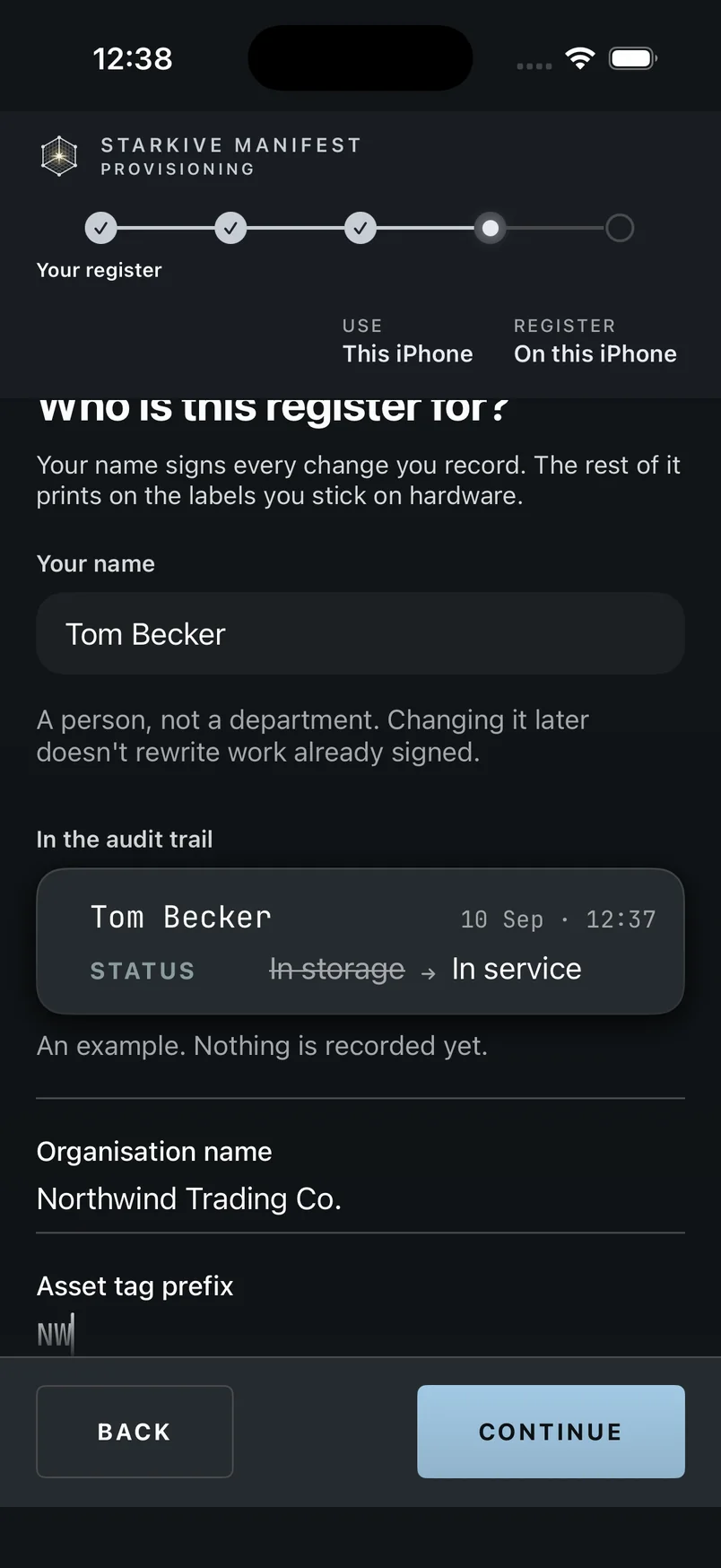
tag_prefix from its server row, so asking here would collect an answer the first sync is about to replace.Organisation name is required. Asset tag prefix is required and validated: the help text reads Every asset gets a tag like STRK-0001. Tags are printed and stuck on hardware, so this can’t be changed once you have started. A prefix that fails AssetTagService.isValidPrefix shows the rule beside the field, and blocks Continue with the same sentence in the footer.
Below that: Currency, defaulted from the device and one picker away; Company size; Industry; Primary jurisdiction; and two toggles, This is a U.S. public company (or a subsidiary of one) and We do business with the U.S. federal government or handle CUI. Choosing Other as your industry reveals Which frameworks apply to you?, a multi-select of every framework, with the note Pick any that govern how you manage hardware. Run setup again from Settings to change them.
Bringing in your first assets
Setup ends on work rather than on a security toggle. The lock and appearance are in Settings, where a reversible preference belongs.
The masthead is Bring in your assets. On the founding track the subtitle is You’re set up. Pick the fastest way to record your first machine — you can mix methods any time. On a phone that joined a fleet it reads Your register is syncing down. You can still record something standing in front of it right now.
Three tiles, and each one is the forward action. There is no commit bar on this step, because a second loud control beside three of them would mean none of the four is the answer.
- Scan an asset tag, badged Fastest: point the camera at a label or QR code, and the register mints a tag for anything it has never seen.
- Photograph the serial: read a printed serial off the machine itself, and confirm it before it is written down.
- Type it in: no label, no barcode, a dead camera, a machine still has to be recordable.
I’ll do this later finishes setup without opening any of them. The note below the tiles reads Appearance and the lock are in Settings whenever you want them.
There is no spreadsheet import and no network discovery on the phone. Its three routes are the three it has a camera and a keyboard for.
What setup writes, and when
Nothing is committed until the last step, and the order of the writes is load-bearing.
Setup settles where the fleet lives, writes what you told it, and hands the shell whichever way in you picked. The mode is settled by the rule rather than by the card you tapped: a phone that chose the cloud and never signed in finishes local, because everything still works and no unpaid register is sitting on a server.
The signature is written first, on every track. It is the only answer here that belongs to the person rather than to the organisation, and the one every subsequent write depends on. Then SettingsRepository.completeSetup writes the profile and the completion stamp in the same transaction, so the register cannot hold one without the other.
If the register on this phone is the only copy and the switch to cloud would destroy it, the switch is what gives way. The phone finishes local, nothing is lost, and the message names the row that carries it across once the organisation’s encryption is set up.
Running setup again
Settings carries Run setup again, and it re-asks rather than resets.
The answers are pre-filled from what the register already holds, so somebody reopening setup to change one answer does not walk out having silently reset their industry, their regulated-data scoping and every framework that followed from them.
The register’s answer outranks the device’s guess. Currency defaults from the locale for a new organisation, but re-running setup on an existing one shows what that organisation actually chose, so walking through it again in another country does not re-denominate your fleet by tapping Continue.
Deleting the app does not delete its keychain items. A fresh install purges every generic password this app holds, excluding anything marked synchronizable, before anything reads a credential. See Security.