Before you start
- Blank NDEF tags, the sticker kind. Anything a phone can write.
- An iPhone. iPads have no NFC radio at all, so the control is not offered there rather than offered and failing.
Open the record and use the antenna symbol
On screenEdit · QR · ⋯
It sits in the toolbar between the QR symbol and the more menu, drawn as radio waves. One tap, from the record, in the same place as the label you would otherwise print. You will not find it in the capture beside this step: that phone is a simulator, which has no NFC radio, and the app hides the control rather than offering one that cannot work. On a real iPhone the toolbar reads Close, then Edit, QR, antenna, more.
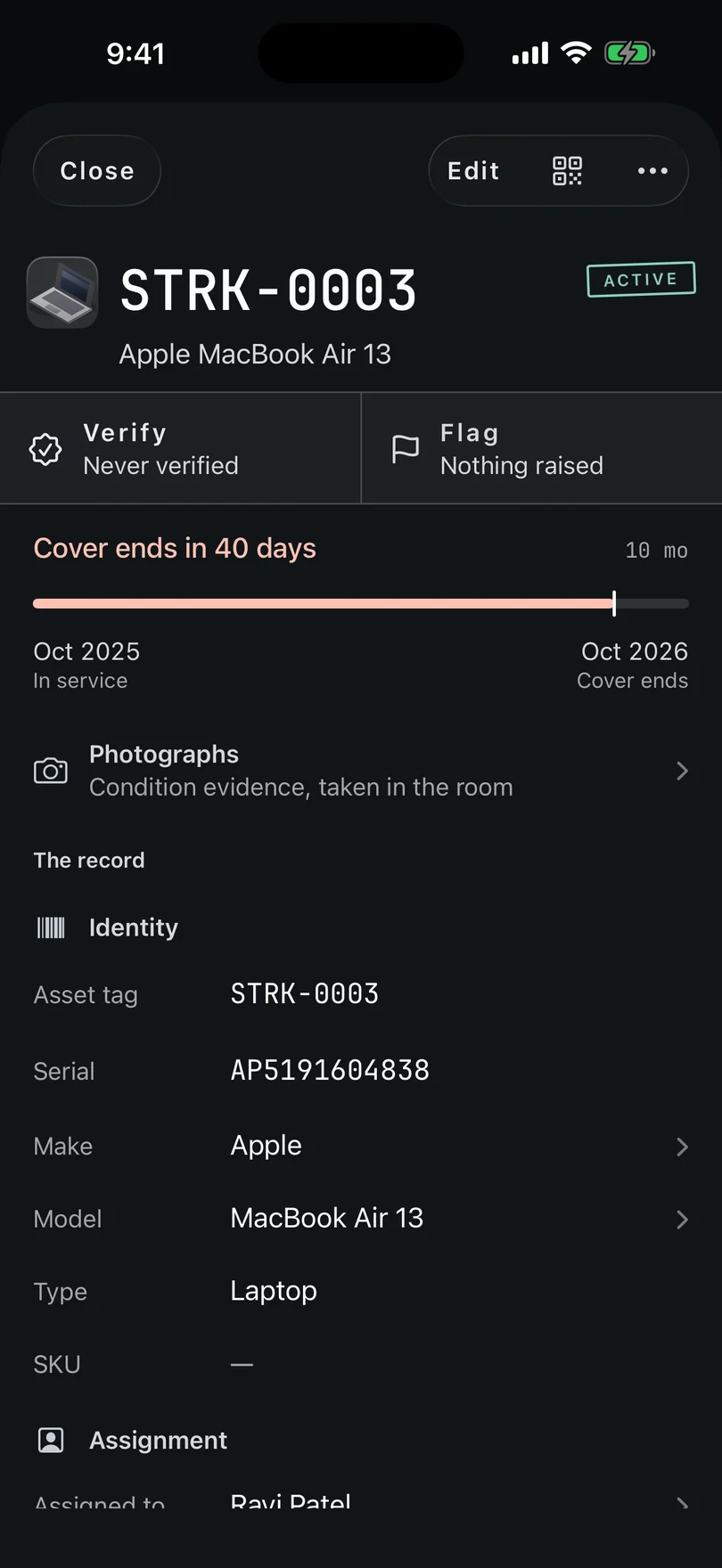
One record, opened. Ceremonies on top, cover next, fields underneath. Hold the top of the phone against the tag
On screenHold the top of the phone against the tag.
The app says exactly that, and iOS takes the radio with its own Ready to Scan sheet. The tag does not need to be on the machine yet; writing it on a bench and sticking it on afterwards works the same.
Tag written. Tapping it opens this record.
On screenTag written. Tapping it opens this record.
That is the confirmation, and it is a promise about what you just made rather than a checkmark. From here the chip is a link to that record for anyone in your organisation holding a phone.
Know what is on the chip, because it is not much
One HTTPS link carrying the register's own key for that machine. No asset number, no serial, no make, no holder, nothing naming your organisation. A chip is readable by anyone who walks past it, with no pairing and no trace, so it holds a pointer and the register holds the facts. Nothing written to a tag can be re-keyed or revoked later, which is exactly why nothing sensitive goes on one.
Read one back from the Scan screen
On screenRead an NFC tag
Read an NFC tag is its own control on Scan, above the camera alternatives, because a tag read succeeds on its own terms and needs no lens. It works when the camera has been refused. A tag that is not one of ours is refused by name rather than guessed at: that tag was not written by this app, or that tag is not on this device.
The record opens from the copy on your device
The link is resolved against the register on the handset, not fetched from anywhere, so a basement with no signal opens it just the same. A phone without Manifest installed gets a web page that explains what it is holding and can tell it nothing about the machine, because we do not have it.
Nothing on iOS notices a tag while the app is closed and acts on it by itself. Background tag reading exists and shows a banner somebody has to tap; there is no entitlement that changes that. If you are hoping to inventory a room by carrying a phone through it, no product on this platform can do that, and ours does not either.
That is the set. Back to all guides.
Stuck on a step, or a screen here does not match the one in front of you? Write to support@depaloconsultingllc.com and say which step. The app moves faster than this page does.